Filenews 7 December 2025 - by Christakis Hatzilaou

Two months ago, the operation of the competitive electricity market (IEE) was launched in Cyprus, with the full implementation of the "target model". The promise was clear: increased competition, more choice and lower prices for the consumer.
But the reality turned out to be different. Cyprus' electricity market has operated with distortions, further burdening the cost of electricity.
A key distortion is found in the determination of the clearing price - in the context of the wholesale electricity market - according to the most expensive unit of the Electricity Authority of Cyprus (EAC) that was needed to meet demand. In this regard, it is emphasized that the wholesale price is a compass for determining the retail price on the consumer's invoice.
We will then proceed to the analysis and evaluation of the two-month operation of the wholesale market. As far as the futures market is concerned, the other main pillar in the AAE - which covers a percentage of 30-40% of daily demand, we reserve the right to evaluate it at a later stage.
Why the wholesale market has operated with distortions;
Because the electricity market of Cyprus is:
▪ Very small – few players in the market (only EAC + RES)
▪ Isolated – no electrical interconnection with neighboring countries
▪ Strongly monopolistic – EAC controls more than 90% of production.
It is clarified that the 'target model' works to the benefit of the consumer in large and interconnected markets (e.g. Germany).In our own small and isolated market, however, it causes distortions that the consumer pays dearly.
How the Wholesale Market Has Worked;
To understand the magnitude of the distortion, it is enough to analyze the daily operation of the wholesale market by time period:
▪ Night & evening (00:00-06:30 & 16:00-24:00): EAC plays alone → Benefit for EAC
▪ Morning & afternoon: EAC + RES play → Benefit for EAC + RES
▪ Midday hours (2-4 hours): They may only play RES or EAC + RES depending on demand → Benefit for the consumer – in case they only play RES.
In a very small market, without interconnections, with only two players and the EAC controlling almost all production, the result is predetermined: The consumer is burdened with additional costs in electricity.
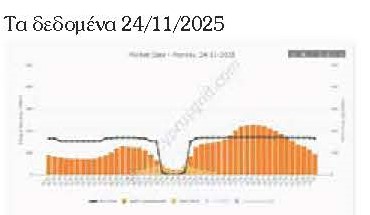
The data 24/11/2025
According to the graph of the "Cyprus Grid" platform, which describes the daily distribution of electricity quantities and wholesale prices per half hour for Monday, November 24, 2025, there is a clear distortion:
SOURCE: CYPRUS GRID PLATFORM
▪ For 22 hours a day, the wholesale price (continuous black line) is determined by the EAC's most expensive conventional unit (deep orange). That is, all EAC units that participate to meet the demand of the half hour are compensated with the price of the most expensive unit, regardless of supply and cost.
▪ Renewables (light orange) participate "competitively" in the market with only 3.4% of daily demand and therefore their weight in determining the price of electricity is insignificant.
In addition to the fact that RES participate with a very small percentage (3.4%), of this small percentage:
▪ Only 1.2% trade at zero wholesale price for 2 hours a day (when demand does not need conventional support).
▪ The remaining 2.2% is compensated... with the price of the EAC's most expensive unit, since demand also needs conventional support!
Result: The entire conventional production is compensated at the half-hourly price of the most expensive unit. The same happens with renewables, since for the most part they are also compensated with the price of the most expensive unit.
The main conclusion of the assessment of the two-month operation of the wholesale marketis that it passes on higher costs to the consumer than the real average cost of production.
What we need
The solutions we need to address this distortion:
1. Immediate Relief: A Cap on the Wholesale Price (2026)
Set a price cap (after studies and according to the actual cost). Every time the price exceeds it, the difference is automatically returned to consumers through a reduction in bills. The price cap must reflect reality so as not to discourage the necessary investments in storage and flexible units. A similar measure was successfully implemented by Spain and Portugal (the 'Iberian Exception' mechanism) from June 2022 to December 2023, capping the wholesale price of natural gas for electricity generation.
2. Permanent solution: Contracts for Difference (CfDs)
A dominant European practice in recent years, which is being applied with increasing success in the United Kingdom, France, Poland, Greece and other countries, to support renewable energy sources and make RES independent from the price of conventional production. According to the European Commission, "CfDs" provide income certainty to investors and protection to consumers, while Greece emerges as a particularly successful example of implementation.
How they work:
▪ The RES producer locks a fixed price (e.g. €80/MWh) through a tender for 15-20 years. ▪ When the wholesale price < a fixed price, → the CfDs Fund pays the difference to the producer.
▪ When the wholesale price > fixed price → the producer returns the difference to the Fund → everyone's bills are reduced.
Result:
✓ Cheaper electricity in the long run ✓ Stability and certainty for investors ✓ Fair distribution of profit when the wholesale price is high
Timeline we can achieve
▪2026: Pilot program "CfDs" for 100 MW of new projects (photovoltaic + storage)
▪2027-2028: Mandatory "CfDs" for all new RES, storage and hybrid
▪projects Critical: Amendment of the law by summer 2026
The success of "CfDs" depends to a large extent on the design of the tenders. For Cyprus, this means tenders with special provisions for hybrid projects (RES + batteries) that enhance investment incentives. As Greece and the United Kingdom have shown, similar measures have been successfully implemented with minimal side effects thanks to good organization/regulation and continuous monitoring.
Inference
The target model applied in Cyprus is not wrong – it is simply unsuitable, as it stands, for the particularities of small Cyprus. We don't need to tear it down. We need to fix it quickly and intelligently, without changing the way it works.
With a temporary ceiling for immediate relief and with Contracts for Difference (CfDs) as a permanent solution, we can have:
▪ Lower bills from 2026
▪ Encouraging new investments in RES and storage
▪ A fairer and more functional system for all
Cyprus does not need another lost five years of expensive electricity, waiting for the market to mature in the long run. We can – and must – build tomorrow with cheaper electricity for every household and business.
* Electrical engineer, with many years of experience in the operation of the Electrical System
