
By Lionel Laurent
Was the fate of Europe decided in Miami? That fear prevailed this week, when European Commissioner Andrews Koubilius condemned the "unacceptable" proposals of the US and Russia to end the war in Ukraine and the fact that Europe seemed incapable of taking the lead with its own proposals. "I am tired of always discussing American plans," he said at an event in Strasbourg organized by the French magazine L'Express. "It would be better to prepare our own."
It is easy to understand Kubilius. Even if the backlash of the likes of Emmanuel Macron and Keir Starmer reduced the Trump administration's 28 humiliating points to 19 more acceptable, the threat of a "Carthaginian peace" punishing Kiev and burdening Europe with the cost has not disappeared. The front line is also stuck, and Ukraine, which, as Trump insists, "does not [ed. keeps] the papers", will run out of cash by February. European leaders' deep dependence on the U.S. on defense, energy, and trade has relegated them to the role of spectators. U.S. officials on Monday scolded the European Union for over-regulating U.S. companies.
However, it would be a mistake to think that Europe has no ace up its sleeve. "Point 14" of the Vitkov-Dmitriev plan tries to cancel its best card, demanding that a significant share of the $300 billion of frozen assets of the Russian state – which are mostly in Belgian Euroclear – be shared between Washington and Moscow and reinvested in reconstruction. This has obviously disappeared from the new versions [of the plan], but the intention is clear. The US sees a profitable way to claim a Trump victory, while Russia sees it as a vital means to deprive Kiev of a lifeline. Europe's reaction was shock, anger and protest.
But it's time to act. A region with a GDP 10 times that of Russia can do more than it has done so far. Persistent objections to using these funds for a repayment loan – including Euroclear, which fears for its own viability – can and must be overcome, either by offering guarantees to Belgium or by finding an equivalent amount. Further indecision leaves the US room to put pressure on Europe, argues Agat Demaré of the European Council on Foreign Relations.
Leadership is needed, ideally from both Germany and France, where the sale of a huge number of fighter jets to Kyiv is being considered. Despite Donald Trump's statements to the contrary, Europe is Ukraine's main donor.
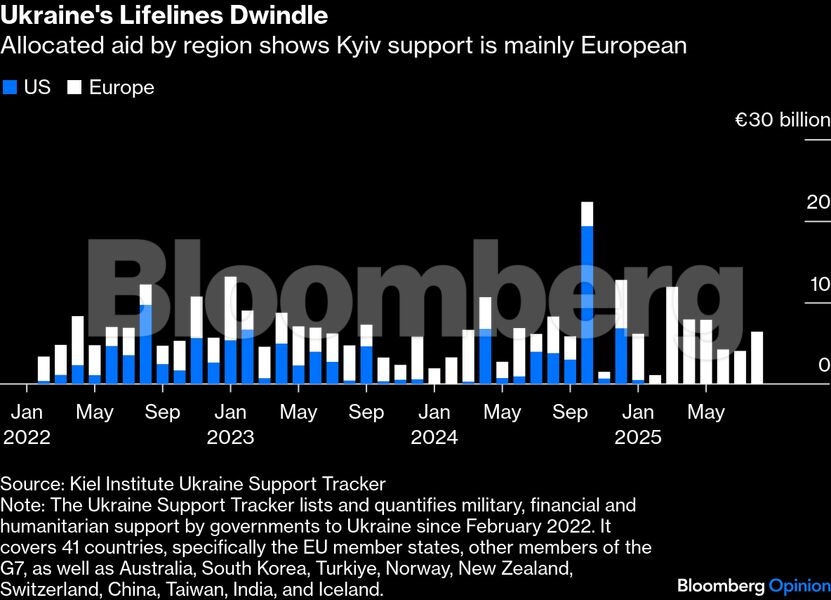
The decision to cross the Rubicon regarding frozen assets should be accompanied by other obvious financing solutions. The cost to rebuild Ukraine will amount to about $230 billion, according to Bloomberg estimates. However, Europe must also pay for its own rearmament, in the face of Putin's aggressive stance. The continent needs solidarity if it is to stand on its own two feet in a world dominated by Trump. Eurozone central bankers have called for more common borrowing to finance common military spending. Given the prolonged stagnation of the German economy and France's fiscal crisis, it makes sense. BlackRock's vice president, Philip Hildebrandt, is one of those planning a new secure asset.
Making cash available – either by releasing assets or by other means – would recognise that Europe's fate as a strategic actor is tied to Ukraine. It would not suddenly bring about a military upheaval on the ground. The harsh reality is that concessions will be needed to end this war: Ukraine will have to accept some loss of territory, its military presence will be reduced, and its NATO membership still seems a long way off. Stepping up anti-corruption efforts will be essential.
However, given the pressure exerted by Moscow itself, with oil revenues vulnerable in the course of sanctions, Europe must do everything it can to resist plans that look more like a bitter capitulation than a peace. Miami is a long way from Berlin and Paris – not the right place to decide the fate of the continent.
Adaptation – Editing: Lydia Roubopoulou
