Filenews 1 November 2025 - by Evagoras Prokopiou

China at the top, Germany in decline — Cyprus 11th in the world and 3rd in Europe
Since the publication of the World Fleet Ranking 2024 by Vessel Value, there have been significant changes in supply chains and fleet modernization. However, little has changed at the top of the list.
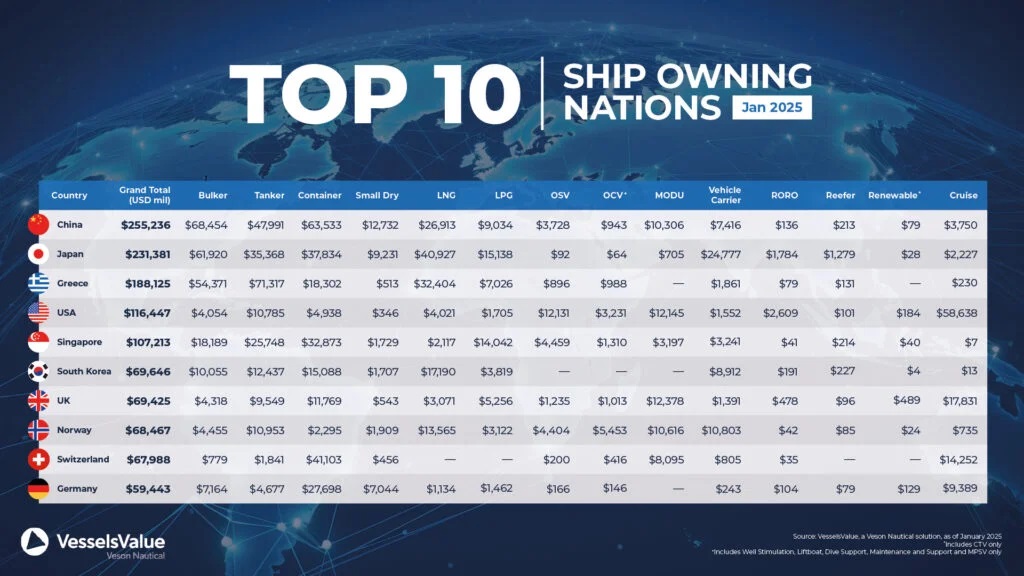
China still outperforms Japan. Chinese shipowners have consolidated the country's leading position, with a fleet worth $255 billion surpassing Japan, whose fleet amounts to about $231.4 billion. Cyprus ranks 11th in the world and 3rd in Europe, while the Cypriot fleet accounts for about 15% of the European Union's merchant fleet, which underlines its importance for the EU. The report highlights significant shifts in asset values and dynamic changes in the shipownership market in 2024.
China also maintains the top position in terms of the number of ships. It also moved into first place in terms of fleet value, reaching €255,236 million, surpassing Japan. This is due to the fact that China has bulk carrier and containership fleets worth $68.4 billion. and €63.5 billion. respectively, while the value of fleets in both of these sectors has increased over the last year.
This development is attributed to the improvement in fundamental market conditions that emerged after the Red Sea crisis, which increased demand for ton-miles in most sectors. To avoid terrorist attacks, ships are forced to lengthen their routes between Asian and European ports, as passing through the Cape of Good Hope has now become the norm. Thus, the value of a 20-year Capesize bulk carrier (180,000 dwt) increased by about 26.98% in the last year, from $13.86 million to $17.6 million.
About 20% of the Capesize merchant fleet (130,000–219,999 dwt) is owned by shipowners based in Greece. 18% are owned by Japanese shipowners and 18% by Chinese. 7% of the fleet is flagged by Bermuda, while 6% is owned by South Korea-based shipowners, according to data from Banchero Costa.
The value of 20-year-old Handy containerships with a capacity of 1,750 TEU also increased by 171.86% in a year, from $5.97 million to $16.23 mil. China also has the largest number of tankers. As of January 2025, its fleet numbered 1,764 tankers with a total value of $47.9 billion.
According to Banchero Costa data, the prices of new tankers, but also those in the secondary market, increased significantly in the second half of 2024 and remained stable in January 2025. This is due to the increased demand for shadow fleets and the expansion of oil and product transport routes.
Japan's power in bulk carriers and Greece in tankers
Japan fell to second place this year, despite the fact that the value of its fleet increased from $206,3 billion in 2024 to $231.3 billion at the beginning of 2025 – an increase of around 12% year-on-year. In recent years, Japanese shipowners have been focusing on strengthening their bulk carrier fleet.
During the year, the Japanese fleet of bulk carriers increased by about 60 ships. The rise in ship values has helped to increase the overall value of the sector. Bulk carrier values have remained close to their highest levels in 15 years. 20-year-old Capesize ships reached a peak of $20.32 million in October 2024.
Japan also has the largest fleets of LNG carriers (worth $40.9 billion), LPG carriers ($15.1 billion), reefer carriers ($1.3 billion) and car carriers ($24.8 billion). The LPG fleet is divided into two categories: small vessels with a capacity of 1,000–12,999 CBM and large, fully refrigerated vessels over 70,000 CBM.
The majority of LPG tankers, 928 units, are small vessels under 13,000 CBM. VLGCs (Very Large Gas Carriers) over 70,000 CBM are 427 units, or 26% of the fleet, but account for 73% of total transport capacity, Banchero Costa estimates. About 19% of the LPG fleet is owned by Japanese companies, 7% by Chinese companies, 6% by Greek companies and 5% by Singaporeans, while another 5% is owned by Indonesian ships.
Greece maintained for another year the third place, both in total value and in number of ships. Although China has more tankers, the value of the Greek tanker fleet is significantly higher, $71.3 billion, i.e.$23.3 billion more than China's, according to Vessel Value. Greece also has the second-largest LNG fleet, with 143 ships worth €32.4 billion increased by about $1 billion compared to last year, thanks to continued high demand for tankers and LNG transport.
The United States is strong on cruise ships
The United States retained fourth place, with a fleet value of $116.4 billion. — an increase of $16.5 billion compared to the previous year. The value of the US fleet is largely determined by the dynamics of the cruise industry, worth $58.6 billion. The leading role is played by Carnival and Royal Caribbean. Since last year, the value of the U.S.-owned cruise ship fleet has increased by nearly $10 billion. The U.S. also has a strong position in the ro-ro market, with a fleet worth $2.6 billion. However, with 40 ro-ro ships (ships specially designed to transport wheeled cargo), they are behind Japan (88 ships) and Turkey (50).
In the top five buyers of ro-ro ships for 2020–2024, Japan leads with 10 orders, followed by Italy's Grimaldi (8 ships) and France (6).
Singapore firmly in the top five
Singapore retained fifth place, with a fleet worth about $107.2 billion. — an increase of more than $21 billion compared to last year. Its shipowners rank fourth in the world in terms of number of ships. The LPG and OSV (offshore support vessels) fleets are the most valuable segments, with a value of $14 billion and $4.4 billion respectively. The value of these fleets increased by 50.5% compared to the previous year, due to the increased demand for maritime gas transport.
South Korea sixth, with investments in LNG and ro-ro
South Korea maintains sixth place, with a fleet worth 69.6 billion. — an increase of nearly $2 billion. from last year. Although it has fewer ships than the tenth country on the list, its fleet consists of newer and high-value ships. The country's position is due to its investments in the LNG sector, with a fleet worth €17.2 billion. Dollars.
Korea remains a key exporter of cars and continues to invest in shipbuilding. The Glovis company ordered six LCTC vessels, worth 125 million euros. dollars each, which will be built at the Chinese shipyard Guangzhou CSSC and delivered by 2028, further increasing the value of the Korean ro-ro fleet.
Britain invests in cruises, Norway in LNG and ro-ro
The United Kingdom moved up one place, ranking seventh in 2025, although it is not in the top ten in terms of the number of ships. As in the US, about 25% of the value of the British fleet comes from the cruise industry, its most valuable sector.
This is followed by the containership sector, which accounts for approximately 17% of the value of the fleet, up 2% year-on-year. The value of the British tanker fleet increased by 32%, from 7,2 billion. in January 2024 to €9.5 billion. in January 2025. Investments in LPG vessels kept the total value of the fleet at stable levels ($5.3 billion).
Norway now ranks eighth, with a total fleet value of €68.5 billion. — nearly $10 billion. more than last year, surpassing the UK. The rise is driven by investments in maritime liquefied gas transportation, including routes from the US to Poland. The Norwegian LNG fleet accounts for about 20% of the total value ($13.6 billion), while the LPG fleet accounts for 4.5% ($3.1 billion) and tankers for 16% ($10.9 billion). Norway is also the second largest owner of car carriers, accounting for 15.8% of the total value of the fleet ($10.8 billion).
Switzerland and Germany round out the top ten
Switzerland remained in the top ten, with a fleet worth 68 billion. mainly due to MSC's activity. In 2024, MSC continued its policy of rapid growth of its container fleet, purchasing 63 used ships and signing contracts for 64 new ones, which will be built in China and delivered in 2026–2029.
Germany recorded a decline for the second year in a row, from 9th to 10th place. The German fleet still consists mainly of container ships. German shipowners rank second in the world in terms of number, but fifth in terms of value, which amounts to $27.7 billion, up from $17.8 billion in 2024.
Cyprus, a Shipping Destination
The merchant fleet of Cyprus is a global shipping powerhouse, ranking 11th globally and 3rd in Europe. In addition, the Cypriot fleet makes up about 15% of the European Union's merchant fleet, which underlines its importance for the EU. Merchant shipping in Cyprus has developed rapidly in recent decades, with Cyprus having evolved into a modern, efficient and integrated shipping center, being one of the three largest ship management centers in the world and the largest in Europe.
The development of maritime infrastructure, the specialized knowledge of human resources and the strategically important bilateral agreements with other states have ranked the Cypriot flag among the highest quality and most competitive. Following international safety and security standards (Paris & Tokyo MoU "White List"), the Cypriot flag maintains a high ranking. As a result, Cyprus has a strong presence and an active role in the decisions of international organizations such as the IMO, the ILO and the European Union.
THE TEN MOST POWERFUL WARSHIPS IN THE WORLD
The ten largest warships in the world, according to international military analyses and naval power data, are those of the United States, China, Russia, India, Japan, South Korea, Great Britain, France, North Korea and Taiwan. The order varies according to the evaluation criteria — such as number of ships, scope, firepower, and technology.
United States
The US has the most powerful naval fleet in the world, with eleven active aircraft carriers, dozens of cruisers, destroyers and submarines. Their presence extends across every ocean, giving the United States global strategic power and operational agility.
China
The People's Republic of China has invested massively in the modernization of its navy (PLAN), which currently ranks second in size worldwide. With an increasing number of aircraft carriers, destroyers, and frigates, China aims to dominate the Asia-Pacific and expand its naval presence all the way to the Indian Ocean.
Russia
Despite the economic challenges, Russia maintains a strong navy with a focus on nuclear-powered submarines. The Russian fleet is considered critical to the country's nuclear deterrent power and its strategic presence in the Black Sea, the Baltic and the Arctic Circle.
India
India is developing a modern and multi-layered navy, investing in aircraft carriers, frigates, submarines, and landing craft. Indian naval strategy focuses on securing the Indian Ocean and countering Chinese influence in the region.
Japan
Japan has a technologically advanced fleet, with state-of-the-art equipment and excellent shipbuilding expertise. Although it is typically described as a "Self-Defense Force", the Japanese Navy is among the most modern and effective in the world.
South Korea
South Korea has grown into a front-line naval power, boasting high-tech destroyers, frigates, and submarines, as well as one of the strongest shipbuilding industries internationally.
Great Britain
The Royal Navy remains a key pillar of Europe's defense, boasting two Queen Elizabeth-class aircraft carriers, as well as surface units and submarines equipped with Trident nuclear missiles.
France
France has one of the most modern navies in Europe, with nuclear-powered submarines, an aircraft carrier (Charles de Gaulle) and a developed shipbuilding industry. The French fleet is actively involved in European and overseas operations.
North Korea
North Korea has a numerous fleet of surface and submarines, although the technology of most of its ships is of an older generation. Despite its limited capabilities, its naval presence is considered significant due to the asymmetric nature of its defenses.
Taiwan
Taiwan has invested in modern ships, frigates and air defense systems, with the aim of protecting its sea lanes and national security against China. Its navy operates mainly defensively but with high technological proficiency.
