Filenews 12 November 2025 - by Fanis Makridis

Foreign experts, analyzing organized crime in Cyprus, in the context of a grandiose program that maps crime worldwide, raise issues about persons who are committed to serving the Cypriot State, but act in a way that serves dark purposes.
In their relevant report regarding crime on our island, they include very specific references, pointing out - for example - that in Cyprus there are "high-profile murders that indicate a territorial battle between criminal groups". However, the findings are not limited there.
In a specific subchapter, the behaviour of natural persons who contribute to crime is analyzed, with experts focusing on members of the police force as well as other state officials, with not so flattering reports.
The actual reference from the report, which we quote, leaves no room for misinterpretation: "The role of organized crime 'actors' embedded in the State has caused increasing scrutiny, particularly in relation to allegations of corruption within law enforcement and state institutions. Reports have emerged involving police officers in facilitating criminal activities, with charges ranging from abuse of power to direct involvement in organized crime. Broader concerns about institutional corruption intensified with the Cyprus Confidential scandal, which revealed weaknesses in state oversight mechanisms. The parliamentary committee on Legal, Justice and Public Order highlighted systemic failures that facilitated illegal financial activities, thus reinforcing the perception of deep-rooted corruption in state institutions."
350 experts
As we have noted, the aforementioned is just one of the detailed observations that stand out from the report of the 350 experts of the Global Initiative against Cross-Border Organized Crime, which every two years compiles and publishes the global crime index.
The analysis is based on the support and evidence of Interpol and the Institute for Security Studies. The data is analyzed by a large team of experts as part of a program, which has been "running" since 2020, funded by the European Union and also receives financial support from Norway and the USA.
Cyprus' score
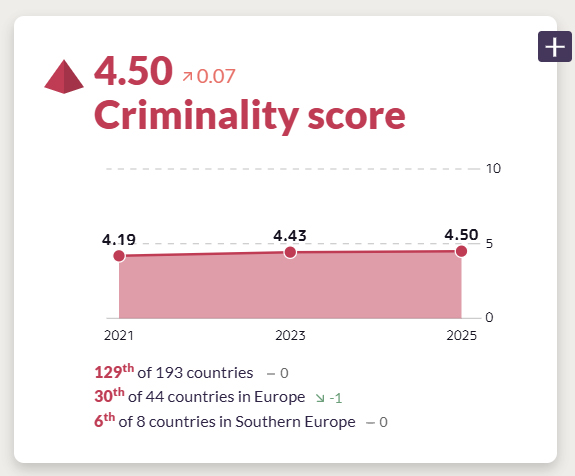
In this regard, Cyprus for 2025 records a score of 4.5/10 and remains at the 129th ranking out of a total of 193 countries evaluated. The lower the ranking in crime a state has, the better the data. It is indicative that in the first three places are Myanmar (8.08/10), Mexico (7.82/10) and Colombia (7.68), countries known for their high crime rate.
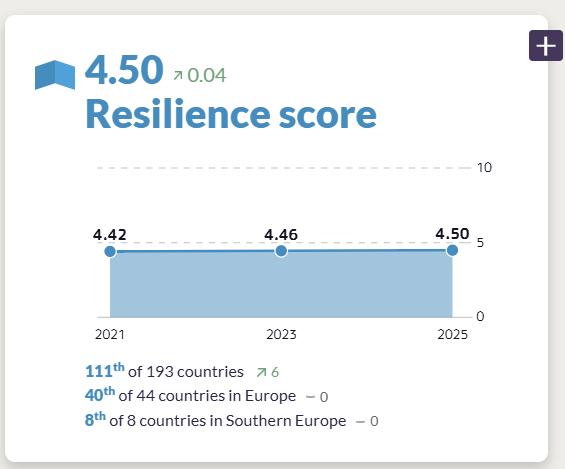
As far as the "resilience" index is concerned, which measures a country's ability to deal with and repair the consequences of organized crime, the news for our island is slightly better than in the previous two years. With a score of 4.5/10 (from 4.46/10 in 2023) it has climbed six steps in the ranking compared to its performance in 2023 and is now 111th.
Very negative in two areas...
What is the number "one" factor that adversely affects our country? Our island records its highest performance in two areas of crime. The first is the area of "foreign actors" which indicates criminal actions in the interior not by locals but by foreigners who are in the Republic (from Eastern Europe, Western Asia and Turkey). The second concerns "illegal immigration".
Cyprus ranks 34th in the world in the category of "foreign actors" of crime and 38th in "illegal immigration". In other words, it has entered the top 40 with the countries that deal with these two issues to the greatest extent.
Turkey and occupied territories
From the analysis, it is clear that the occupied territories – directly linked to Turkey – have a particularly negative effect on the criminality of the Republic of Cyprus. What is recorded leaves no doubt.
The references to the pseudo-state, which is presented to be an incubator of illegal actions, are continuous. Even on the issue of timber from Turkey, which had infiltrated the Cypriot market through barricades and had been revealed by "F", is included in the report. It should be noted here that Turkey in 2025 has "written" a very high score in crime and is in 10th place worldwide.
In particular, with regard to the occupied territories, the report, recording data on how they affect the crime of Cyprus, focuses on the arms trade (note: they are not large-scale), illegal tradable goods, immigration, illegal trade in consumer goods with a special tax (e.g. tobacco products), fuel smuggling, drug trafficking and Money laundering (through casinos and gambling in the pseudo-state).The accusations that Cyprus "writes" high
Cyprus' highest score is recorded in the following areas:
>> Foreign actors (s.s. natural persons) of crime – 34
>> Illegal immigration – 38
>> Agents (s.s. natural persons) of the private sector – 78
>> Trade in counterfeit products – 80
>> Illicit trade in taxable goods – 81
>> Cocaine trafficking – 89
>> Technology-Dependent Crimes – 95
>> Mafia-type groups – 98
>> Trafficking and exploitation of persons – 100

"Cyprus has demonstrated an ability to maintain stability"
- Transparency and accountability remain important issues
As we noted, Cyprus appears to have risen six notches in the index that measures "resilience", i.e., the ability of a state through its mechanisms to prevent, detect and deal with organized crime.
In fact, the introductory reference to this sub-chapter is particularly positive for the government. What follows, however, in the following lines cannot inspire complacency in anyone.
"Cyprus has demonstrated an ability to maintain stability in leadership and governance. The government has declared a commitment to the fight against organised crime, with political leaders highlighting law enforcement measures against criminal networks" is recorded in the first points of the analysis on the "resilience" of Cyprus and then added: "However, concerns remain about the extent of the influence of organised crime in the country (...) Transparency and accountability remain important issues. Public opinion surveys show that corruption is widely seen as a serious problem, with a significant percentage of Cypriots expressing distrust of state institutions. The creation of an Anti-Corruption Authority and legislative provisions to protect whistleblowers represents efforts to address these problems. However, there are criticisms about the effectiveness of anti-corruption initiatives, especially with regard to enforcement and oversight mechanisms (...). Cyprus has a strong legislative framework aligned with international commitments, including the ratification of important treaties such as the UNTOC and several bilateral agreements against organised crime. Despite these contexts, challenges remain in law enforcement, particularly in extradition cases where delays have allowed suspects to evade prosecution. The country has strengthened cooperation with international organizations, notably the US, to strengthen financial crime investigations. Despite Cyprus' participation in Europol and INTERPOL, challenges remain in ensuring a timely and effective response to cross-border crimes."
In the sub-chapter "criminal justice and security", it is noted - among other things - that "the shortage of judges and the increase in cases have further burdened the system, resulting in low efficiency". Regarding the Police, it is noted that "investigations show concerns about corruption in the body". In addition, on the "economic and financial environment", the experts judge that Cyprus "has a long history as an area of financial secrecy, making it vulnerable to money laundering" and that despite the fact that anti-money laundering regulations have been put in place, "international assessments have highlighted ongoing shortcomings, particularly in the implementation of the recommendations of the Financial Action Task Force (FATF)). Despite improved enforcement measures, concerns remain about the effectiveness in asset recovery and the prosecution of financial crimes."
