Filenews 5 October 2025 - by Marios Demetriou

"It is a mistaken belief that as soon as you remove a victim of human trafficking from the situation they are experiencing, the case has been resolved and that they have the access and support they need, from the competent services and this is tragic, because many people who are victims (not only asylum seekers, but also citizens of the European Union), continue to struggle on the margins of society and do not have the comprehensive professional support they should have."
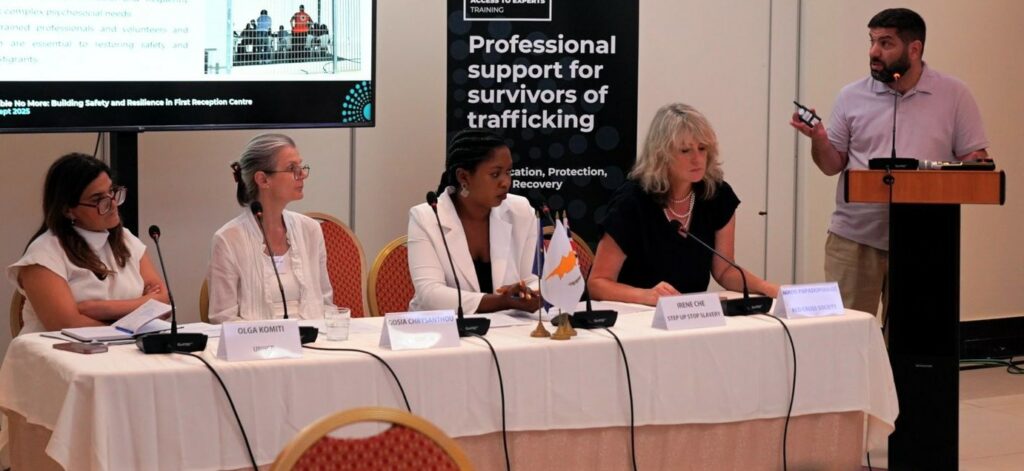
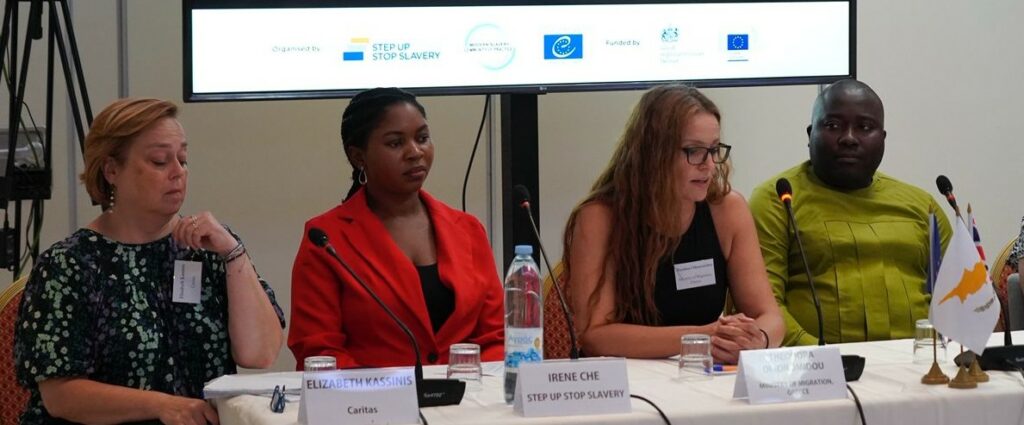
The above was pointed out by Elizabeth Kasini, executive director of the charity Caritas Cyprus, which operates in Cyprus, against poverty and exploitation of vulnerable and marginalized people, speaking at a panel discussion in the context of a 4-day international educational conference on "Access to Experts" for the professional support of survivors/victims of trafficking in human beings. The conference took place on 15, 16, 17 and 19 September 2025 in Nicosia and was co-organised by Katerina Stefanou, managing director of the non-governmental organisation Step Up Stop Slavery and financial compliance consultant in Nicosia, Rachel Witkin, international anti-trafficking consultant and director of the "Modern Slavery Community of Practice" in the UK and Jane Lasonder, award-winning global leader in human trafficking survivors and vice-chair of the International Advisory Council on Human Trafficking Survivors (ISTAC). The problem, however, does not only concern Cyprus.
As mentioned by Rachel Witkin who moderated the discussion, "it is important to recognise that meeting the needs of survivors, as soon as possible and as fully as possible, is an investment in society as a whole. In every country – he added – many adults and children victims of human trafficking, are neglected, disappeared or victimized again, by traffickers, in an environment hostile to them and friendly to traffickers and other criminals." This pioneering interdisciplinary event, funded by UNHCR in Cyprus, was attended by dozens of experts mainly from Cyprus and the UK, but also from Greece, Latvia and Malta, in person, or via recorded video, or via live internet connection. The language of the conference was English.
"In Cyprus, you have to know who to ask..."
The panellists, in which Elizabeth Kasini participated, addressed the issue of access for survivors of human trafficking crimes to services, in the whole range of sectors that concern victims. Ms. Kasini said that "unfortunately, it is up to civil society and individuals to address the gaps in the anti-trafficking system. There may be a National Reporting Mechanism, social workers, a hotline and anti-trafficking police, but these services are not aligned and do not work in coordination with each other. There is a whole range of challenges and delays, with huge costs for victims and survivors of trafficking in human beings. In our system, you have to know who to ask... The hardest thing for us, frontline workers, is that when an emergency arises, you try through the system to deal with it, but when you do it the second time, it's not a given that the system will respond in the same way, which means you're wasting energy unfairly – the system doesn't respond effectively, each time and in every case. The most pernicious thing, from my point of view, is denial. Civil society must constantly highlight the fact that the system does not work for these cases of victims."
Trafficking of men, asylum applications and "Pournara"
Stephane Noel Tchouanteu, founder and director of the Bridge of Hope organization in Cyprus, which helps, supports and reaches vulnerable people, including victims of human trafficking, but also people with disabilities, who experience additional marginalization and barriers to access services, described his own experience. He said, among other things, that "when we talk about human trafficking in Cyprus, we mainly think of women, especially in the context of sexual exploitation.
However, many men are victims of labour trafficking, afraid to speak out and are ashamed of what they have been through, especially those who come from Africa, where the cultural background "wants" men not to show weakness and to keep everything inside them." Regarding the difficulties of witnessing victims of exploitation, in the context of their asylum application in Cyprus, he said that "when we arrive here at the first migrant reception center "Pournara", we receive a form and are told to write our story. But we are newcomers and scared and it is difficult to write about what we have been through, because when we come here, we do not know what human trafficking is. Only after a few months do people feel they can share what they experienced as victims of trafficking. But when the time comes for the interview for the approval of the asylum application and they want to talk about the experience of their victimization, they are "condemned" by what they wrote the first time, when they arrived in "Pournara".
The above was reinforced by Olga Komiti, representative of the United Nations High Commissioner for Refugees in Cyprus (UNHCR Cyprus), speaking "about the gaps in the process of identifying victims of human trafficking and the need for capacity building and training in the asylum system". He stressed that "victims of human trafficking are re-injured by repeated interviews, which look like interrogation. These interviews focus on the credibility of the victims, rather than the careful gathering of information and the assembly of the story."
Nikos Papadopoulos, head of psychosocial support of the Red Cross Cyprus, also referred to the "Pournara Migrant First Reception Center", where the "Transition Project" of the Red Cross Cyprus is implemented, stating that "the living conditions there are temporary, unstable and often inadequate to meet complex psychosocial needs". Gosia Chrysanthou, representative of Caritas Cyprus, pointed out that "the cost of rent is much higher than the minimum allowance received by asylum seekers, while the housing conditions provided by unscrupulous property owners are degrading. Along with the bureaucracy they face when it comes to obtaining housing, asylum seekers can be led to homelessness and inability to access even basic food and clothing! This puts victims at huge risk of being re-victimized by traffickers." In a video on the subject, Peter Parker, head of survivors from the UK's Modern Slavery Community of Practice, referred to "the situation of young people forced to live with criminals, under the same roof... Having personal experience in this – he added – I see that young people are an easy target for criminals and can become victims of human trafficking and trafficking again and exploitation".
Victim identification and multi-service training
Petya Nestorova, Executive Secretary of GRETA (Group of Experts on Action against Trafficking in Human Beings), which monitors the implementation of the Council of Europe Convention against Trafficking in Human Beings in all signatory countries, presented an overview of the recent GRETA report on Cyprus, published in 2025, stressing "the need for a victim identification system, which does not depend on the prosecution of their traffickers". He focused on the importance of training social workers, asylum workers, health care providers, prison staff and other professionals to identify victims of human trafficking (Article 10) and urged the authorities "to ensure that all potential victims of human trafficking receive the assistance measures they are entitled to". For her part, Alessia Vedano, Anti-Trafficking Advisor, from the Office for Democratic Institutions and Human Rights (ODIHR) of the Organization for Security and Co-operation in Europe (OSCE), said that "functional and effective National Reporting Mechanisms are essential. We need – he added – coordination so that victims do not lose their identity, to ensure that they are recognized, that they receive the support they are entitled to by law, that they regain their lives and reintegrate into society, without the risk of re-victimization."
Health for survivors and professionals
An experiential workshop aimed at raising awareness of the "Vicarious Trauma" experienced by professionals working with and for survivors of human trafficking, was presented at the conference, in the context of the "Health First" section, by Xenia Papandreou, counselling psychologist and Emma Michael, expert in yoga and therapeutic mind-body techniques, who collaborate with the Step Up Stop Slavery in Cyprus. It was about how to recognize the early warning signs of indirect trauma, understanding the neurobiology of stress and empathy, sustainable practices for professional and organizational resilience, and self-care methods. Practical exercises were shared that enable practitioners to adopt sustainable practices, which support personal, professional and organisational resilience. In the same section, presentations on the physical and mental health of survivors of human trafficking were made by medical consultant Dr. Jane Hunt and clinical psychologist Dr. Eileen Walsh, while video was presented by forensic paediatrician Dr. Laura Carolyn Wood.
Complaints to the Police and guidance of victims
Through a live link, Julie Currie, coordinator of the "Victim Navigator Programme" of the organization "Justice and Care" in the United Kingdom, explained the work of victim guides in the United Kingdom and some other countries, in providing specialized support to victims of human trafficking, who want to report their victimization to the Police, but they often feel anxious and afraid to do so. Ms Currie, who was previously a detective in the Metropolitan Police, where she had a long career specialising in crimes related to exploitation and human trafficking, said victim navigators in the UK had supported 747 victims since the start of the project and that 72 exploiters had been sentenced to a total of 478 years in prison as a result of victims' cooperation. He added that "without the support of the 'victim guides', the national participation rate in the process is 44%, while with their support, it increases to 97%".
A former victim of online exploitation and a surviving leader also made reference to online exploitation, who made a series of practical recommendations for law enforcement, focusing "on the need for a full explanation and investigation of issues related to the cybersecurity of victims and the theft and use of their identity online".
Finally, we note the topic entitled "Support for frontline professionals working with unaccompanied children victims of human trafficking", developed by Theodora Economou, Head of Vulnerability of the General Secretariat for Vulnerable Persons and Institutional Protection of the Greek Ministry of Migration and Asylum, who participated in the work of the conference, together with the expert on gender equality and protection of victims of human trafficking from Greece, Elina Karagiorgi.
