Filenews 4 August 2024

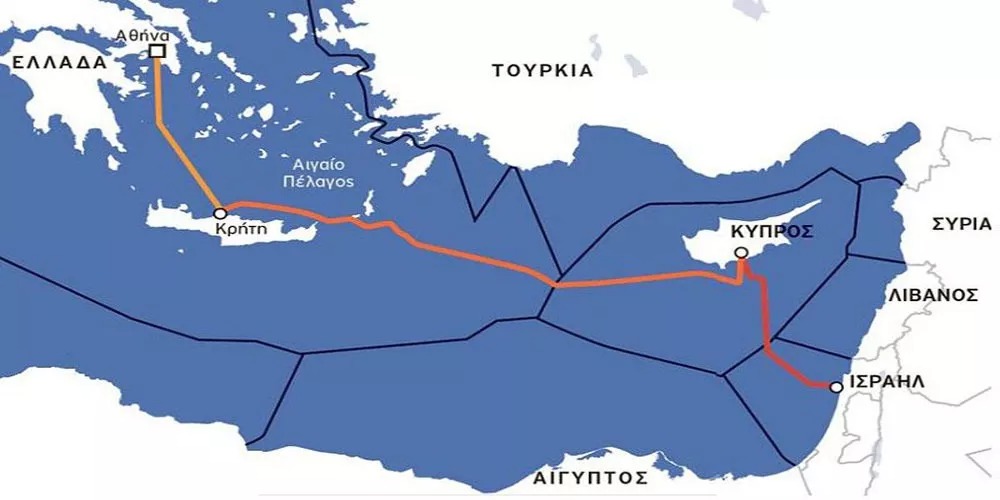
Ambitious ideas don't always mean they're feasible. Regarding the electricity interconnection between Crete and Cyprus, the reason. The notorious Great Sea Interconnector has so many gaps and so many ambiguities in implementation, that the question arises: Will this project have a real and substantial benefit to Cypriot consumers or will we still have to pay out of our own pockets for something that will never be implemented?
By Costas Georgiou
Energy sufficiency, undoubtedly, is of paramount importance and priority for every country. So, the first question on the table is whether Cyprus' energy dependence on another country, even if that is Greece, is really the optimal solution and the desired scenario for an independent state? Because the Great Sea Interconnector was conceived when the data and needs of Cyprus were very different from what they are today.
However, the questions that arise, and no one has answered or clarified yet, are repeated. What will ultimately be the final cost of this project? Because from an estimated €1.5 billion we have reached €1.9 billion and the project has not even started yet. How can the viability of a cable which, as everything indicates, will cost more than €2 billion and which has secured €657 million as a grant from European Union funds, depend so much on the point in time at which recovery begins? How is it possible that a regulated project is not viable? How can we, as a state, have confidence in the Independent Power Transmission Operator (ADMIE) in Greece – which undertook to proceed with the implementation of the electricity interconnection – when the practices it has demonstrated so far are the concealment of data, the distortion of data and the exerting pressure through ultimatums to the Republic of Cyprus? At the same time, it is not in a position to give any guarantee whatsoever regarding the final cost of the interconnection.
The Cyprus Energy Regulatory Authority (PAEK) has put the brakes on the unpretended demands of ADMIE, which thus voluntarily requested that the charging to Cypriot consumers begin with the start of works and not with the start of operation of the cable. PAEK has rightly decided to start charging consumers with the commercial operation of the project and not from January 1, 2025, a few months from now. At the same time, PAEK decided not to change the methodology for calculating the rate of return on capital, which would mean that from time to time the already scandalous preferential rate of 8.3% return would increase even further. It also decided that there will be no additional financial collateral for the project in case it is interrupted in its course, with IPTO assuming the risk of implementation. The useful life of the project and repayment should be set at 35 years instead of the 25 years requested by IPTO. Simply put, PAEK seems so far to be fulfilling its mission, which is none other than protecting consumers from further charges and delays.
ADMIE, of course, instead of respecting PAEK's unanimous decision, launched an undisguised blackmail in order to change the decision of an independent regulator of another, independent state. Indeed, CERA's President, Mr. Andreas Poullikkas, stated unequivocally that the Authority is under pressure from everywhere to change its decision by mid-August, otherwise ADMIE warned that it will stop the project. Instead of ADMIE threatening, why simply does it not give the guarantees that CERA urgently requests that the final cost of the project will not increase beyond the 1.9 billion estimated so far?
The answer is obvious and comes through the mouth of the Minister of Energy, Commerce and Industry, Mr. George Papanastasiou, who at the meeting of the House Standing Committee on Energy on July 30 mentioned that there are two uncertainties that may differentiate the amount of the project. The first concerns the non-signing of the contract – and the cost it will provide – between ADMIE and Siemens, regarding the electricity voltage converter stations in Kofinou and in an area of Crete. The second uncertainty has to do with the final choice of the underwater corridor that will pass the cable connecting Cyprus with Crete.
Controversial cost, however, is not the only issue, as this project is characterized by uncertainty in every aspect. Its feasibility study has not yet been evaluated. The sounding in the sea area where the cable will be laid by Nexans and ADMIE's negotiations with Siemens for the converter stations will be completed in September 2025. These technical difficulties can have two things, either they will further increase the cost of the project - which we consumers will have to pay - or the project will never be completed and we will once again be spectators in the same project.
For a project that we did not say the most important. That it will base Cyprus' energy future on a cable, which will pass through Turkey's illegal declaration of an EEZ with Libya. A country that repeatedly harasses and expells survey ships from the Cypriot EEZ, and it is impossible to predict how it will react at the critical moment in relation to the cable and what consequences any reaction may have on the implementation of the project. The Minister before the House Standing Committee on Energy stated that ADMIE asked CERA to include a provision in the regulators' decisions that will allow the implementing body to recover the costs it will make for the project until the point when geopolitical reasons may require its interruption or termination, without the responsibility of ADIME. On this issue, CERA requested the position of the Ministry of Energy on whether the state will cover the uncertainty arising from geopolitical reasons. That is, in case Turkey creates a problem, ADIME will not suffer any damage and will bear no responsibility, while the state, see taxpayers, will be asked to pay for a project that may never be implemented.
This is in connection with the fact that the Cypriot state is invited to participate with 100 million euros in the shareholding structure of IPTO's subsidiary, the Great Sea Interconnector. The Minister of Energy argues that there are many investors who have shown interest in investing in the electricity connection, but have not yet reached an agreement with ADIME because they are waiting for the decisions of the Republic of Cyprus first. They need, in a way, a state guarantee. But what exactly is the guarantee of the Republic of Cyprus for its participation in a project that is only on paper? Why have these investors not been on the table for 14 years, despite securing a donation of EUR 657 million from the European Commission and the political support it receives?
At the moment, the ball is in the court of the Christodoulides government, which has to decide whether to take responsibility for guaranteeing - in essence - an unsustainable project, which has been guaranteed a return of 8.3%. An amount to be guaranteed by the state and payable by consumers. It must also formally clarify what will happen if construction costs soar further and shareholders are urged to add more capital. Will the government need to participate with much more than 100 million? And if so, explain to us consumers the charges we will have to pay on every electricity bill.
At the same time, things can be much simpler. Because sometimes the numbers speak for themselves. If we focus as a country and as a state on completing the processes for the arrival of natural gas, the reduction in the price of electricity will be of the order of 40%. In combination with the installation of storage systems, our country will be energy autonomous and with a further reduction in the price of electricity another 20%. On the other hand, the reduction in electricity prices with the electricity connection between Cyprus and Greece – always provided that it will be implemented – will be of the order of 30%, according to ADIME itself. Therefore, someone should explain, and especially the Minister of Energy, Mr. Papanastasiou, why it is in the interest of every Cypriot taxpayer and every consumer that this project is in the interest of every Cypriot taxpayer. And why, in the midst of so many still open issues, the Minister himself seems to have such a clear position in favour of participating in this work.
The Christodoulides government is therefore obliged to decide wisely and on the basis of the database whether this time the public interest will finally prevail. Because it is time for both of them to realize that the pockets of Cypriot consumers cannot afford to pay for any more mistakes.
