Filenews 27 August 2023 - by Angelos Nicolaou

A new publication of the Ministry of Agriculture, Rural and Environment entitled "Myths and truths about companion animals" addressed to children, seeks to overturn widespread myths that have prevailed in society about pets, in order to promote their well-being. In simple and understandable language, the book highlights the place that companion animals should have in our lives and the obligations we have towards the animals we have chosen to have in our lives.
This book is part of the animal welfare enlightenment program that will be implemented in the new school year. The whole action is included in the Governance Program and provides for the implementation of animal welfare actions and presentations in primary schools. Already, the interest shown by teachers in this book is very great, and the Ministry, responding to this interest, posted the book on its website.
Objectives and contributors
The book "Myths and Truths about Companion Animals" emphasizes that the bond created between children and companion animals is very strong. Animals offer love, protection and emotional support, helping children develop confidence and empathy, the ability to better recognize the feelings and needs of others. Unfortunately, despite the progress that has been made in animal welfare in recent years, many people are not aware of the basic needs of their pets, resulting in them not being cared for and suffering.

Focusing on the younger generation, the aim of the book is to overturn misconceptions about pets, helping children better understand the needs of animals, thus ensuring their well-being.

The authors and coordinators of the publication are the Officers of the Ministry of Agriculture, Rural and Environment, Marina Michaelidou-Kadi and Haris Nicolaou, while the publication was supported with their knowledge by Veterinary Officers and other scientific collaborators. The illustration was undertaken by visual artist Ioanna Avraam.
The content of the book
The book presents 27 myths, which touch on a wide range of animal welfare and are divided into four main thematic sections:
1. Proper care and welfare of pets.
2. Interaction of pets with children.
3. Pets and breeding.
4. Exotic and wild animals.
>1. Unit-In this section, the book debunks myths about animal welfare, such as the widespread perception, for example, that animals belong outside, in the yard or in a cage, and not inside the house. A walk in the neighbourhood or in the countryside is enough to realize that there are dogs that are kept in unacceptable conditions. In the book we learn that pets evolved close to humans and suffer when they are forced to live isolated for long periods without human companionship. Dogs, for example, are the first animal domesticated by man and have lived near us for 25 thousand years. Through this symbiosis, a very strong bond has been created. Forcing a dog to live away from our family – which in its eyes is also its own family – is one of the worst punishments.
Another widespread myth is that animals, unlike humans, have no emotions. This misconception may explain the harsh attitude some people have towards animals. The truth of course is that animals experience a multitude of emotions, such as excitement, joy, sadness, anxiety, loneliness and fear. Animals not only empathize as we do, but they can read our facial expressions and sense when we are happy, angry, or sad. Studies have even shown that the bond between us and our pets is so strong that many times their emotions coincide with ours, meaning they feel joy when we are happy or sad when we are sad.
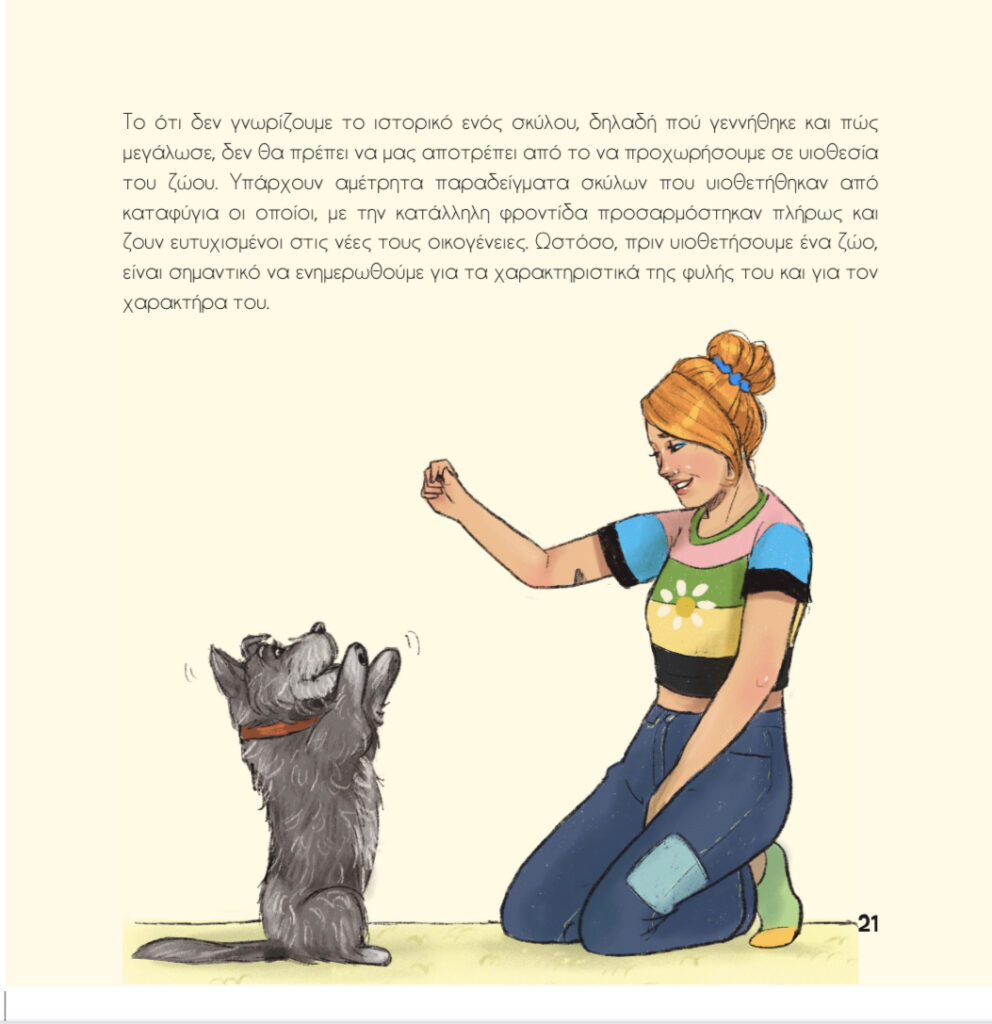
>2. Module – This section concerns the interaction of companion animals with children. One of the prevailing myths is that dogs coming from shelters have problematic behaviour and are dangerous, especially for children. This perception does not hold water. A dog can end up in a shelter for many reasons, such as unplanned dog births, owners who were not prepared to take on the responsibilities required to care for a dog, moving to another country, death or illness of the owner, etc. There are countless examples of dogs adopted from shelters who, with proper care, fully adapted and live happily in their new families. In fact, they reciprocate a lot of love to their new owners.
Another widespread perception that leads to irrational worry and fear is that animals transmit disease because of children's low immune systems. Studies have shown that children who live with pets, especially dogs, are less likely to develop respiratory infections compared to children who grow up without an animal in the same space. Particularly important is the contribution of animals to raising children with mental and motor difficulties, behavioral problems, cardiovascular diseases, etc.
>3.Module – The module focuses on the breeding of pets. A myth we often hear in Cyprus is that pets who live in a fenced area in the yard or inside the house do not need to be neutered. This perception often leads to unplanned births of dogs or cats, increasing the problem of overpopulation of stray animals in our country. The truth is that even if our pets do not move freely outside our space, they can be approached by another animal, following its instinct, which is very strong. A male dog, for example, can spot a female dog in heat within a two-kilometre radius and will do anything to get close to her. Like our pets, during mating season they may escape during their walk or find a way to escape to be with other animals of their kind.
The myth that a female animal must give birth at least once, before being neutered, also does not hold water. According to scientific data, neutering animals contains more benefits than risks. Neutering in both females and males reduces the chances of developing various types of cancer, such as breasts, but also other related diseases, such as pyometra in females and prostate diseases in males. Not neutering our pets contributes to the problem of overpopulation of stray animals. Shelters in our country are full of abandoned and stray dogs, who are looking for homes for adoption. The problem with stray cats is also great, since they breed uncontrollably and there is already overpopulation, as a result of which the animals themselves suffer.
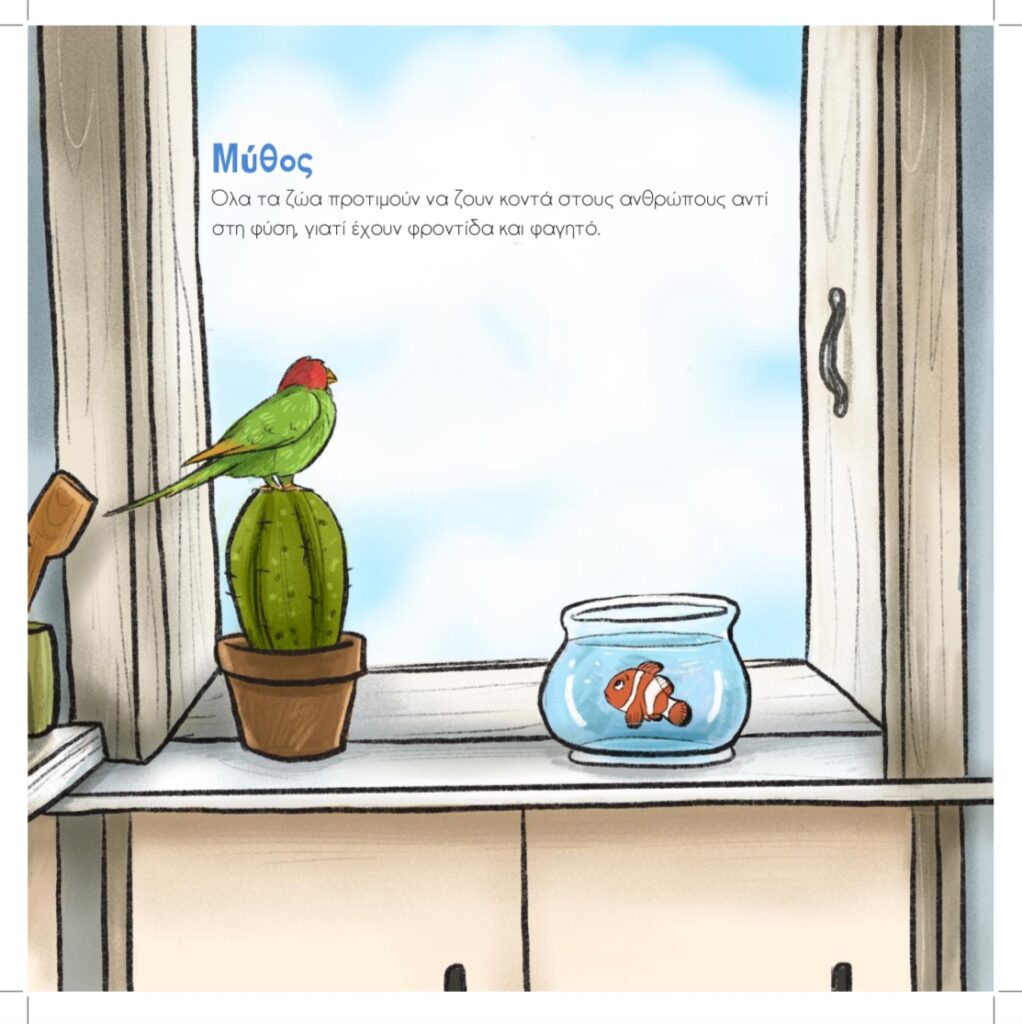
>4.With regard to exotic or wild animals, i.e. animals that did not evolve to live close to humans, the book clearly sets out the message that these animals are not the best option to have as pets, as they suffer during capture, transport and detention in captivity. The myth that all animals prefer to live close to humans instead of nature, because they have care and food, is not true. Unlike domestic animals, which evolved close to humans and with proper care, can lead a good and happy life, wild animals have different needs and suffer when kept in captivity. Some of these animals, for example, would have to live in herds or social groups, and do not thrive when kept alone, without other animals of their kind. No matter how well-intentioned their owners may be, they certainly cannot offer them the life they would have in their natural habitat. In Cyprus, following a recent amendment of the legislation, the detention of wild mammals as pets is prohibited.
The book also overturns the notion that when someone can no longer care for an exotic pet, they can give them their freedom by releasing them into nature. The truth is that any escape or release of certain species of animals into the wild, can cause serious and irreparable problems to the local fauna, since they operate in competition with each other, with the risk that the native species will eventually be displaced. Also, an animal raised in captivity where it is dependent for its food from humans, will hardly survive.
Marina Michaelidou-Kadi:
Journey to the world of animals with love and empathy
Children have an innate love for animals and a keen interest in learning about behaviour, emotions and the animal world in general. It is up to us to cultivate this love and empathy, without transferring to them our own fears and misconceptions.
Personally, my long contact with animals, especially dogs, was decisive in many moments of my life and I am glad that I had the opportunity to collaborate with remarkable scientists for the publication of this book.
The book is part of a comprehensive animal welfare enlightenment program to be implemented by the Ministry of Agriculture, Rural Development and Environment, which is based on the principle of respect for animals and the elimination of conditions that cause them pain, suffering and fear.
Haris Nicolaou:
Animals deserve kindness and respect
Animals have been an integral part of our lives for many thousands of years. It's never too early to teach our children that every living creature deserves kindness and respect, while at the same time it's a huge responsibility to interact properly with their furry friends.
A pet's unconditional love can do much more than keep us company.
It can reduce stress, improve our health and even help children develop their emotional and social skills. My long involvement with both wild animals and companion animals was the reason that prompted me to collaborate and write this book, which through the awareness programs of the Ministry of Agriculture, Rural Development and Environment for animal welfare, became a reality.
