Filenews 8 July 2023 - by Ioanna Mantziria

A treasure trove of antiquities from a 17th century shipwreck has been claimed by the Republic of Cyprus since 2019.
This is a serious and at the same time interesting case that concerns the state since 2015, with the confiscated antiquities found on the Panamanian-flagged research ship Odyssey Explorer, being of great value, since they are objects from 14 different cultures.
The dispute has lasted for years, with the confiscated antiquities being in the hands of the Customs Authorities of the Republic and the case being brought to justice. The Republic of Cyprus is now called upon to prove to the Court that the matter falls within and concerns International Law, even referring to the fight against the trafficking of antiquities.
As "F" reveals, the case is being heard before the Civil Court of the Limassol District Court with the Republic of Cyprus, specifically the Department of Antiquities, as the plaintiff, and the American company, Odyssey Retriever INC, as the defendant. and through her lawyers, she is seeking damages ranging from half a million euros to 2015 million euros.
The lawsuit, according to information provided by "F", was registered in 2019 before the Limassol Civil Court and about a month ago the hearing began. According to the same information, various persons who were directly involved in the case were recently summoned and testified as prosecution witnesses, such as officers of various Departments and the Police, with the trial continuing.
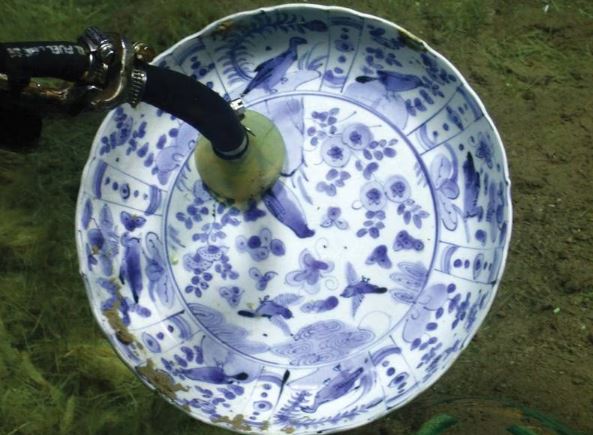
From 14 different cultures
The history of the confiscated antiquities is of great interest not only for the narrow boundaries of Cyprus, but also for other countries, as there is a question of looting antiquities. In fact, the issue came back to the fore three years ago following reports by foreign news media, with the Department of Antiquities in April 2020 stating as follows: "The above company is very well known both in Cyprus and in other countries and international organizations such as UNESCO for its antiquities smuggling activities in maritime zones and aims to sell objects, as can be seen in the documents the company filed with the US Securities Exchange (NASDAQ)."
According to statements by British archaeologists, the ship with the precious treasure sank in 1630 and was found at a depth of 2 kilometres above sea level. Among the antiquities are Chinese porcelain, jugs painted in bright colours from Italy, and estimates suggest that the ship may have sunk while traveling between Egypt and Istanbul.
588 items in a special area of the ship
Following instructions from the Legal Service, the case was classified as non-police in nature and instructions were given to the customs authorities, while the captain of the ship was issued an extrajudicial fine of €40,000.
According to the facts of the case, in December 2015 the Ministry of Foreign Affairs informed the Police that the research ship named Odyssey Explorer, conducted searches between October and December 2015, in a sea area between the EEZ of Cyprus and the EEZ of Lebanon, while in December the ship docked at Limassol Port.
The Police deemed it necessary to search the ship, as it was suspected that the ship in question, as well as the American owner ODYSSEY MARINE EXPLORATION INC conducted searches for antiquities and recovered them from the EEZ of Cyprus. A search of the ship followed on the same day by departments of the Limassol Police Headquarters, the Department of Antiquities and the Limassol Customs, following the issuance of a court warrant. During the search, a storage area was found inside the ship, which was locked and controlled by closed circuit surveillance, in which 57 plastic boxes in which these antiquities were stored. The Department of Antiquities, after first ascertaining that they were indeed antiquities, proceeded to confiscate them and they were transferred to a special area, where they were placed under the guard of the authorities.
Further investigation and recording revealed that these were 588 ancient objects among which there were Chinese porcelain and other great ancient objects, which were well preserved and packaged so as not to suffer any damage.
Video of the haul
The whole process of retrieving the antiquities was recorded on video that the authorities found, after they had received a specific document. As "F" is aware, a hard drive had been located on which the research and recovery of antiquities, the depth and geographical position from the seabed of Lebanon's exclusive economic zone were recorded. In fact, it was found that a specific machine – robot – was used to retrieve the antiquities. The recovery of the antiquities was found to have taken place in the Lebanese EEZ and the evidence remains in the possession of the Department of Antiquities to this day.
