Filenews 22 July 2023

Until a few years ago, the state built privately owned buildings that functioned as refrigerators in winter and as ovens in summer, and now tens of millions of euros are being spent on energy upgrades. It is characteristic that only in the programming period 2021-2027, the cost of energy upgrades of public buildings will amount to €45 million.
The relevant data show that even buildings built at a later stage have worse energy performance than other public buildings built earlier, which points to incorrect planning and a wasteful state, which did not respect the taxpayer, who pays the bill (through the budget) nor the environment.
Along the way, the project of energy upgrading of public buildings was undertaken by the Ministry of Transport through the Department of Public Works, in cooperation with other public services.
Essentially, the effort began in May 2013, when, under the instructions of the then Minister of Transport, a working group was set up (under the coordination of the Department of Public Works) in order to prepare an action plan for the preparation of an energy efficiency program in public buildings.
Recently, the Minister of Transport, Mr. Alexis Vafeadis, asked for information on the "standing" of the state in terms of energy efficiency of its buildings.
One of the objectives of raising the issue is to take any measures imposed to ensure that Cyprus complies with Article 5 of Directive 2012/27/EU for energy savings per year (3,316 GWh) and the implementation of Article 14 of the Energy Efficiency Laws of 2009 to 2015.
In the briefing note sent by the Department of Public Works to Mr. Vafeadis (dated June 21, 2023), it is stated that for the implementation of the relevant provision of the Law and the EU Directive, the Energy Service of the Ministry of Energy prepared a report to the European Commission entitled "Alternative approach to improve the energy performance of buildings owned and used by central government authorities (in accordance with paragraph 6 of article 5 of the Directive 2012/27/EU on energy efficiency (Exemplary role of central government buildings)").
The report also includes a list of buildings owned and used by central government authorities over 250 sq.m. In this list 175 buildings have been recorded. The categories of buildings exempted from the obligation to comply with the minimum energy performance requirements as provided by the Energy Performance of Buildings Regulation Laws of 2006 to 2012, as well as buildings belonging to the armed forces or the central public administration and serving national defence purposes, have not been included. The catalogue records building data such as name, address, use, energy consumption and energy class.
The Deputy Director of the Department of Public Works informs the Minister that in addition to the €45 million that will be allocated for the energy upgrade of public buildings (under the Structural Funds for the period 2021-2027), another €15,415,000 has already been allocated. This envelope was made available through the 2014-2020 Structural Funds and subsequent projects have been implemented.
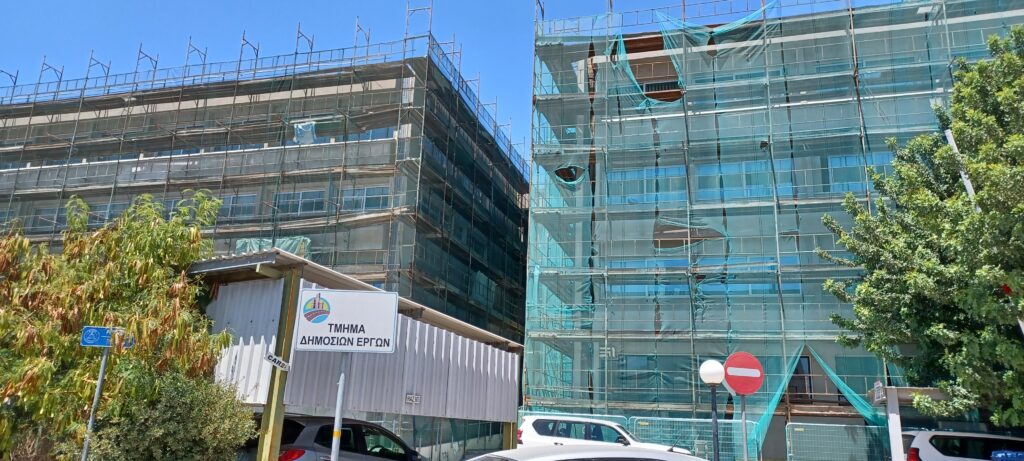
The ones that were upgraded
–Energy upgrade of Pafos government offices of 11.000 sq.m. Energy class after upgrade B+ from Z, H and E. The project has been completed in 2021. Contract amount: €6.690.000 plus VAT.
–Energy upgrade of a 1,800 sq.m. Commissioner building Energy class B+ after the upgrade from D. The project has been completed within 2022. Contract amount: €1.299.000,00 plus VAT.
–Energy upgrade of headquarters and district engineer of the Department of Public Works, 7,000 sq.m. Energy class A after the upgrade from Z. The project is in progress. Contract Amount: €7.426.000,00 plus VAT.
To achieve annual energy savings of 3,316 GWh, the following will be implemented:
> Radical renovations that will upgrade the building to a building with almost zero energy consumption.
> Deep renovations that will upgrade the building to national minimum energy performance requirements.
> Individual energy saving measures (e.g. lamp replacement, roof insulation, RES, etc.).
> Measures to improve user behaviour for rational use of energy.
The tools / actions through which the upgrading of the energy efficiency of public buildings is promoted / implemented are the following:
i. Through structural programmes.
ii. Through European cross-border cooperation programmes.
iii. Through the state budget.
iv. Through energy performance contracting (EPC) with the public-private partnership (PPP).
The first three actions have been standard practice for several years. Energy performance contracting (EPC) is a new practice for Cyprus, both in the public and private sectors.
Which buildings will have zero consumption?
The note of the Department of Public Works to the Minister of Transport states that all new government buildings promoted from 1/1/2019 are zero consumption, in accordance with article 5A of the Regulation of the Energy Performance of Buildings Law N. 142(I)2006. The following buildings implemented by the building sector of the department are nearly zero energy buildings:
> Headquarters of the Department of Lands and Surveys.
> Mental Health Centre in Nicosia (Phase A).
> New Cyprus Museum.
> Pancyprian Blood Centre.
> Ayia Napa Fire Station.
> Construction of a Accommodation Centre "Limnes" in the Menogeia area of Larnaka district, for applicants for international protection and a pre-removal centre for persons to be repatriated.
> Law Office of the Republic.
In the relevant briefing text to the minister, it is stated that climate change imposes the necessity of transition to green and low energy requirements and carbon emissions construction.
It is noted that public buildings should become a model in this field. The aim, through the energy upgrades in the Government's building stock, is to achieve the implementation of more and more demonstrative energy projects & actions in buildings and public sector facilities. The main concern of the Department of Public Works is through a coherent and targeted holistic methodology (regarding the energy upgrade of buildings) to contribute to the promotion of energy saving actions, the encouragement of the use of RES, with the basic criterion of common interest and the multiplication of results in all buildings in general except public ones.
Identifying the building with almost zero energy consumption, the Department states that it is a building with very high energy efficiency, whose almost zero or very low amount of energy required, is largely covered with energy from renewable sources, including that produced on site or near the building.
