BBC News 1 April 2022 - by the Visual Journalism Team

Counter-attacks by Ukrainian forces are successfully regaining territory in several areas as Russian forces regroup and refocus their efforts on operations in the east of the country.
Here are the latest developments on day 37 of the invasion:
- Ukrainian forces retaking key positions around Kyiv
- Shelling remains ongoing in Kyiv and in Chernihiv
- Russian troops said to be withdrawing from Chernobyl
- Port city of Mariupol remains likely to fall to Russia soon
- Ukrainian forces repelling Russian attacks in the Donbas
- Russia redeploying troops to Ukraine from Georgia
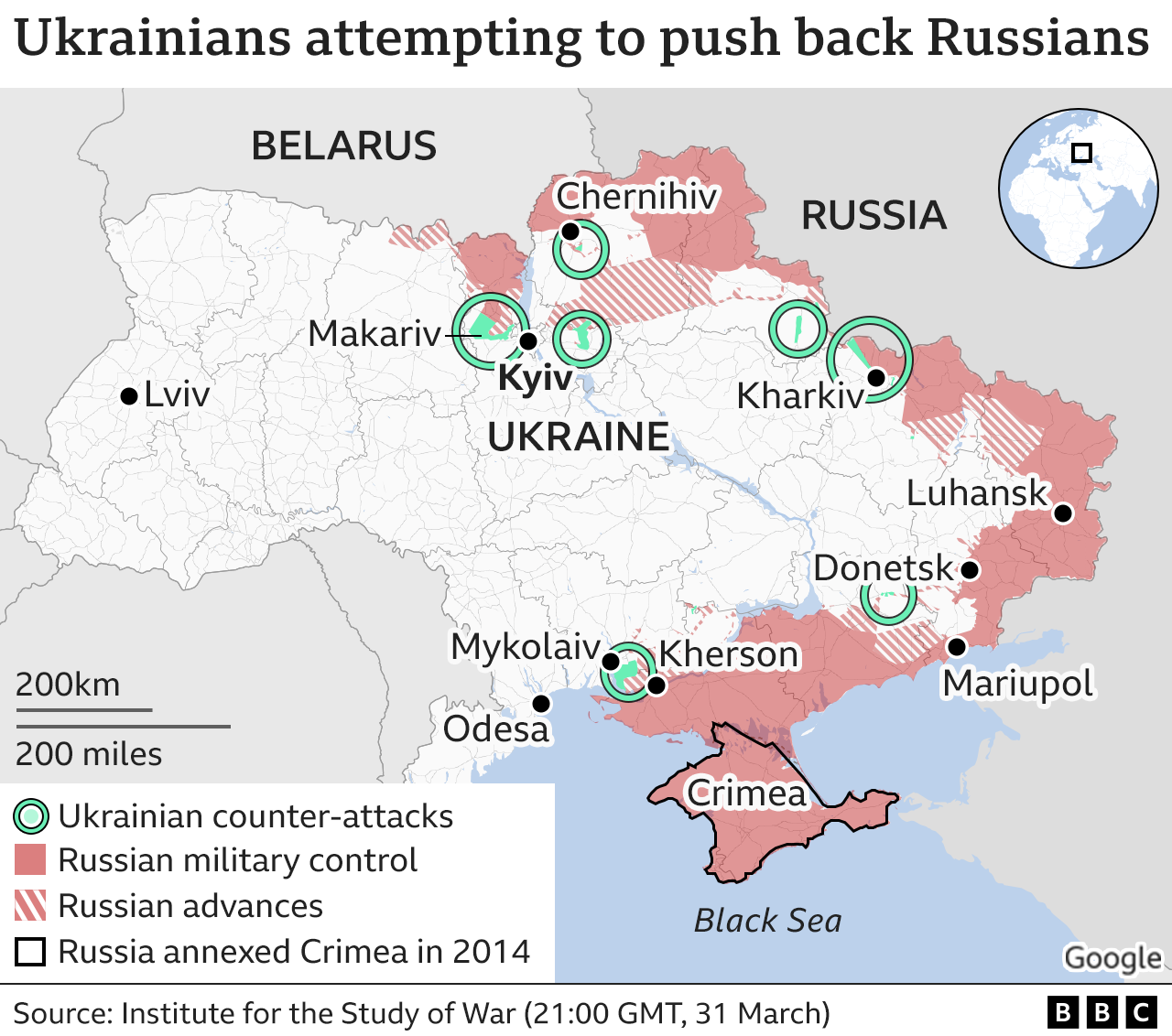
Russia launched its attack on 24 February, but five weeks into the war it is having to bolster its forces by redeploying troops from Georgia after suffering "unexpected losses," according to the UK Ministry of Defence (MoD).
Ukrainian counter-attacks have pushed Russian troops back in a number of places and the MoD says that Russia is struggling to sustain its operations across multiple areas of engagement.
Ukrainians fight back around Kyiv
Russian forces have lost ground around Kyiv in recent days and they have moved from trying to encircle the capital to withdrawing to positions that are more easily defended, according to Jack Watling, a defence analyst at the Royal United Services Institute.
Ukrainian forces have successfully pushed Russian troops back in a number of areas on the outskirts of Kyiv, including in the suburb of Irpin about 20km (12 miles) to the west.
These counter-attacks are pushing Russian artillery further out of range of central Kyiv, but shelling of the suburbs has continued as Russian forces try to defend their positions.
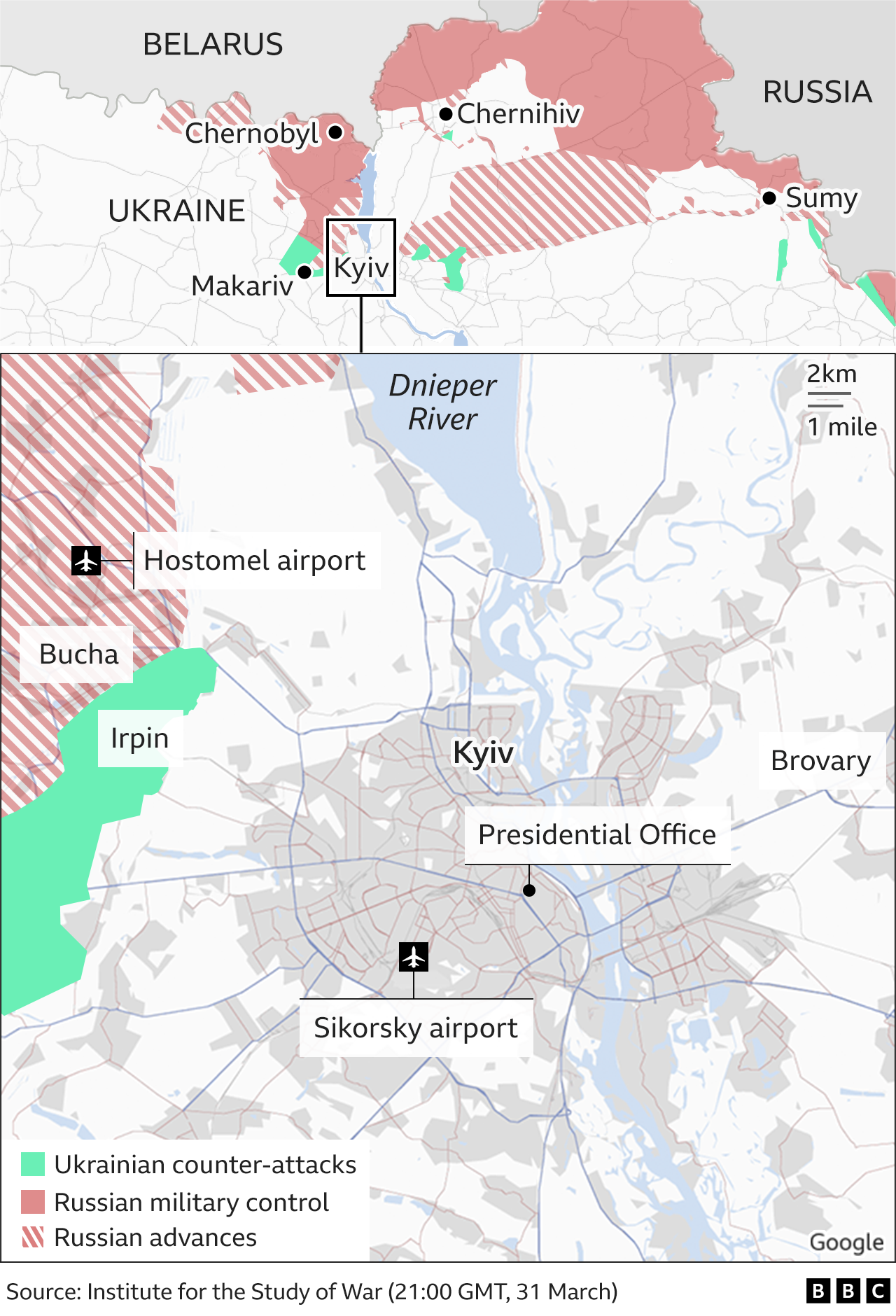
To the east of the capital, Ukrainian forces have reclaimed ground from the Russians around the suburb of Brovary, about 20km (12 miles) away from the centre of Kyiv.
The Russian advance on Kyiv from the east has been hindered by the failure to take control of Chernihiv, a major city to the north-east that sits between the capital and the Russian border.
The aerial bombardment of Chernihiv has continued in recent days, but analysts at the Institute for the Study of War (ISW) say some Russian units are being withdrawn from around the city - and from around Kyiv, Chernobyl and Sumy - to be redeployed in the east of the country.

Russian progress slows in the south
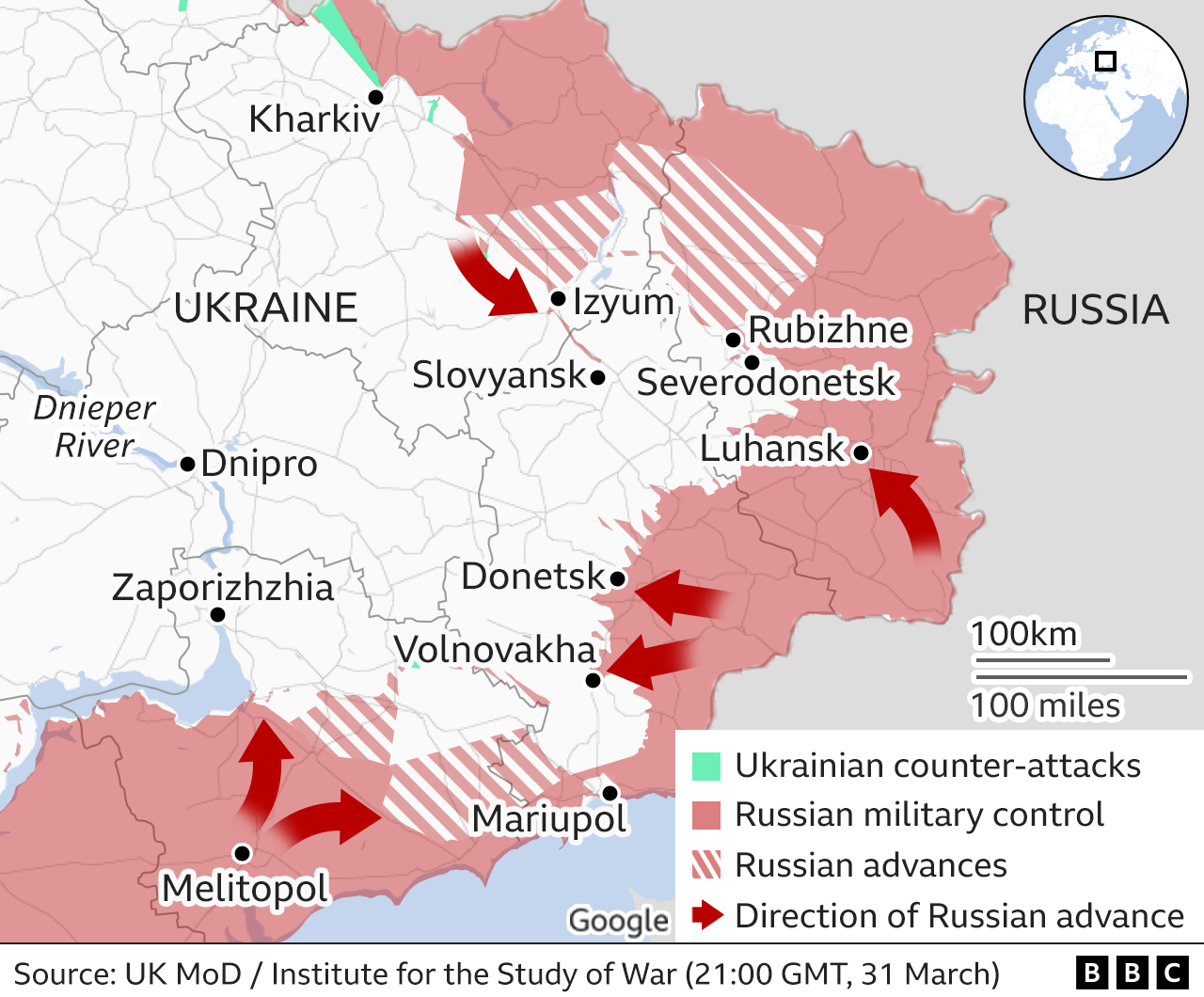
Russian forces initially made rapid gains in the south, with their main objective being the creation of a land corridor between Crimea, which it annexed in 2014, and areas held by Russian-backed separatists in Donetsk and Luhansk.
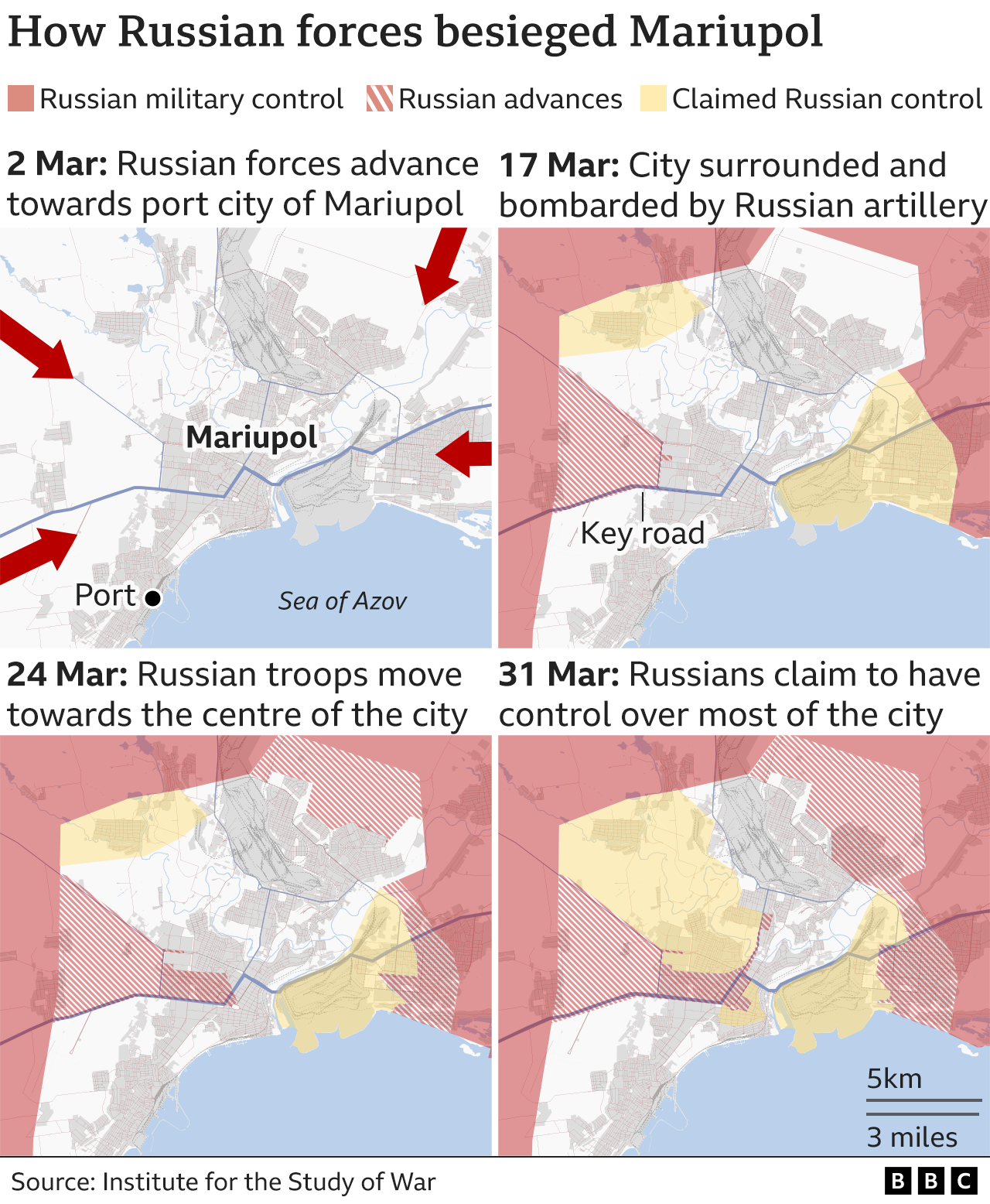
Standing in the way of that objective has been the port city of Mariupol, which has been encircled by Russian forces since the start of March.
Russian forces have been advancing further into the centre of Mariupol recently and the city is likely to fall within days, according to the ISW.
More than 100,000 civilians are thought to be trapped in the besieged city and its deputy mayor says people there are dying from starvation and dehydration.
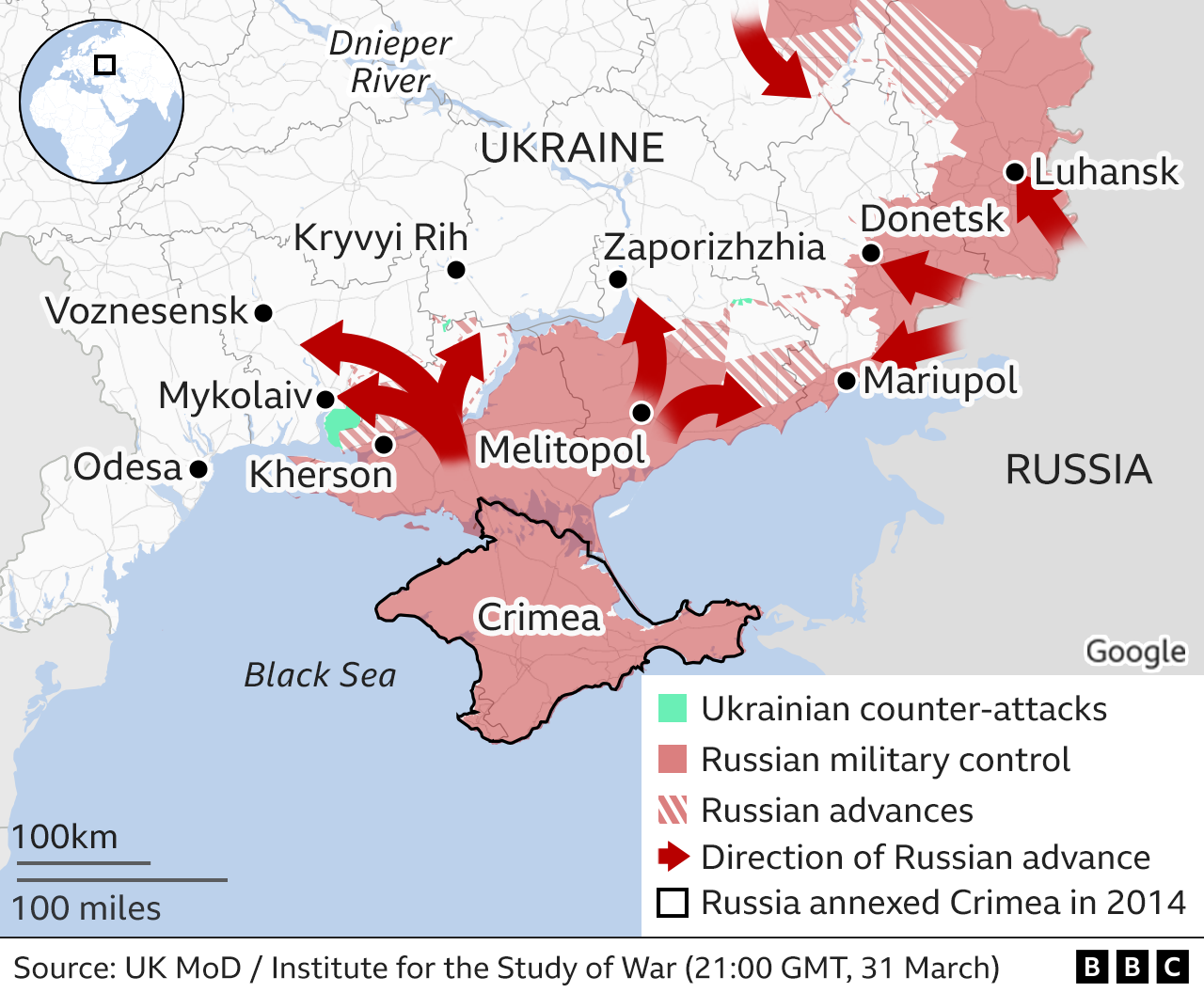
To the west, Russia had been attempting to push towards Odesa, with the aim of cutting off Ukraine's access to the Black Sea.
But their advances stalled at Mykolaiv, where a counter-attack by Ukrainian troops has pushed Russian forces back towards the city of Kherson.
Russian troops in the area are now concentrating on maintaining their current positions rather than taking new ground, according to the ISW.
Russia targets full control in the east
With recent setbacks elsewhere in the country, Russian officials have said that the focus of its forces is now the "complete liberation" of the Donbas.
The Donbas broadly refers to Ukraine's eastern regions of Donetsk and Luhansk, where Russian-backed separatists held significant territory before Russia's invasion.
Analysts says Russian forces in the region are trying to encircle Ukrainian troops there by advancing from Kharkiv to the north and Mariupol from the south.
But Ukrainian forces have repelled several recent assaults, particularly around the town of Rubizhne, and Russian forces have failed to make any significant gains recently, according to the ISW.
By David Brown, Bella Hurrell, Dominic Bailey, Mike Hills, Lucy Rodgers, Paul Sargeant, Mark Bryson, Zoe Bartholomew, Sean Willmott, Sana Dionysiou, Joy Roxas, Gerry Fletcher, Jana Tauschinsk, Debie Loizou and Prina Shah.
About these maps
To indicate which parts of Ukraine are under control by Russian troops we are using daily assessments published by the Institute for the Study of War with the American Enterprise Institute's Critical Threats Project.
From 2 March this daily assessment differentiated between "Assessed Russian-controlled Ukrainian territory" and "Assessed Russian advances in Ukraine", the latter indicating areas where Russians are believed to have launched attacks from but which they do not control.
To show key areas where advances are taking place we are also using daily updates from the UK Ministry of Defence and BBC research.
The situation in Ukraine is fast moving and it is likely there will be times when there have been changes not reflected in the maps.
