Cyprus Mail 16 January 2022 - by Bejay Browne
 |
| The demonstration in Chlorakas on Saturday - CNA |
As tensions rise in Chlorakas, Syrian nationals living in a particular development who have been given just days to leave and find new homes following ongoing problems in the village, have called on the government to urgently step up to help resolve the situation peacefully because the situation “is a tinderbox waiting to explode”.
Hundreds of Syrians living at the complex have to be relocated by Monday but authorities have nowhere to take them. No practical solutions have been found after meetings this week with the parties concerned.
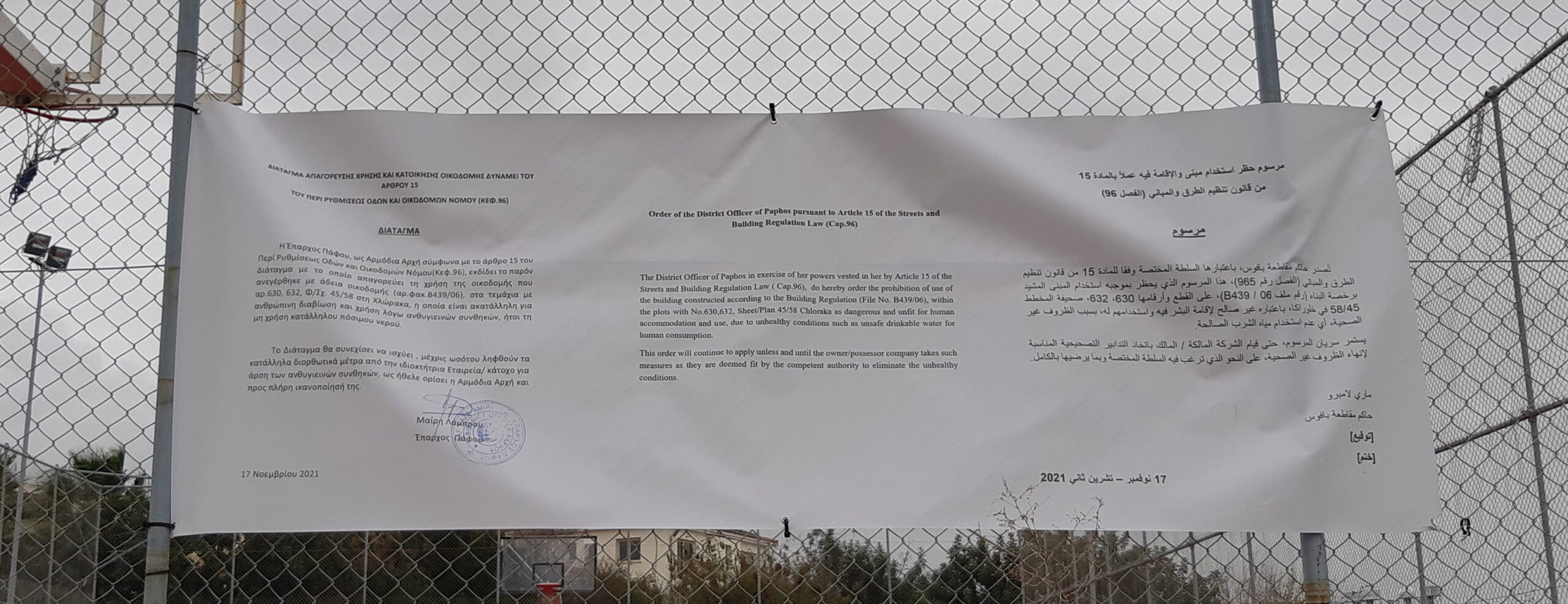
The Paphos District Officer issued a decree last November for their relocation due to ‘unsafe living conditions’. It was not enforced due to practicalities. It is also not clear which authority is ultimately responsible for their relocation as the law does not define this because it concerns a number of ministries.
Meanwhile, the local community board has been accused of racism and exhibiting far-right views in their handling of the situation, a claim it vehemently denies. Residents of Chlorakas last week, staged a protest complaining of ‘ghettoisation’ of the area following a flood of third country nationals, many of which, according to the local authority are illegal migrants.
They held another demonstration on Saturday.
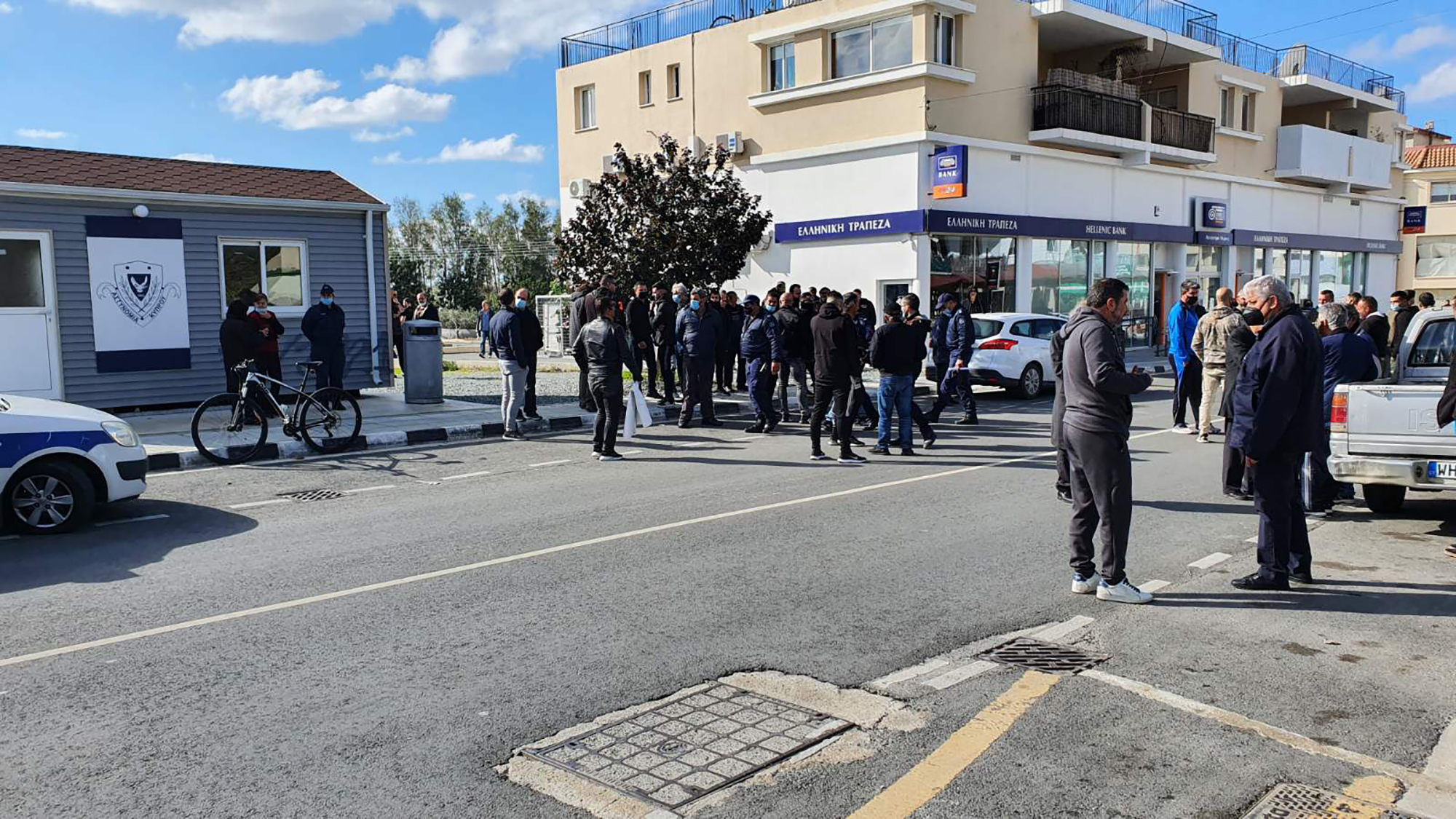
The protests came after a brawl in the village almost two weeks ago. Fifteen people have been arrested since and police have carried out three sweeps in Chlorakas in the past ten days. The suspects will appear in Paphos district court for a hearing on February 24.
Most are facing charges of conspiracy to commit a misdemeanour, rioting and disturbing the peace, while three were also being charged with breaking and entering as well as assault.
There is currently an interior ministry decree in place banning any more Syrian refugees from settling in the coastal village. In addition, the district office has declared some of the complex in question unfit for human habitation due to “unhealthy conditions, such as unsafe drinking.”
Kisa, Action for Equality, Support, Antiracism, has filed a report to the attorney-general and the chief of police against the leader of the local community council, Nicolas Liasides, for hate speech and inciting attacks and violence, as well as against members of the police.
It said the authorities were indiscriminately targeting a social group on the basis of characteristics protected by law.
Doros Polycarpou of Kisa, told the Cyprus Mail that the actions should be considered as violating the law and abuse of power.
“The police are entering apartments on this complex without their permission, treating them like terrorists, searching, checking documents and taking them to the police station, just because they arrived after the decree, which is being challenged anyway. This is police terror.”
The background to the development is complex and a number of court cases involving the owners are pending, according to a spokeswoman for the company.
“There are many cases at the court at present and our lawyers advised us not to comment on the situation. The community board and others that are commenting should not be doing so, as it is like giving a verdict without a trial. They are putting together things that are not connected I have no comment to make,” she said.
After the development was built, much of it was sold using loans from Alpha bank to British buyers. Polycarpou said. But they lost their properties. The bank approached the guarantors to clear debts and the company took possession. This created a vacuum: unable to sell and unable to buy. So for economic reasons, they rented to asylum seekers, refugees and migrants, he said.
“The government did nothing to help or support the local community deal with increased numbers and now they must leave, but to go where? They need money to do that,” he said.
There is a disagreement between the development owners and the municipality over water bills, and supply to parts of the complex has been cut This is being used as an excuse to declare the affected blocks unfit for human habitation, he said.
“We agree that the authorities should get any outstanding money for water supply but oppose the policy of using the situation against people. They don’t want a solution, they just want them out.”
Many Syrians have lived there for longer than two years before the decree and are suffering.
Paphos police confirmed that patrols in the area have been stepped up.
“Following two large fights in Paphos and the problems at the complex in Chlorakas, police operations were increased, and along with the MMAD members from Nicosia, a number of arrests were made,” a police spokesman confirmed.
He added that they were also implementing action following the decree.
Along with arrests for fighting and other charges, officers also took illegal residents to the police station to make a statement and inform them to leave, and want to charge the owner of the building, he said
One of those rounded up by police was a father of two from Idlib, Syria. Police gave him seven days to leave the complex with his family. They arrived by boat around eight months ago. The boys are aged two and a half years and six months, the latter was born in Cyprus.
The refugee spoke to the Cyprus Mail through an interpreter, saying he was shocked.
“We (Syrians) are not all the same, we fled here to Cyprus for a safe life for our family and now we have just days to leave our home, it’s just not possible, we don’t have the money” he explained. “We feel like a tinderbox, as if everything could go off at any time. If they (the authorities) want us to leave, why don’t they help us find somewhere to go.”
The family stayed less than a month at the overcrowded Pournara camp, before arriving in Paphos, choosing the development in Chlorakas to settle’ it was the only place that didn’t require a deposit or advanced rent.
“We couldn’t imagine it would be like this. We don’t get involved in trouble, we don’t agree with it. They say to us, you are Syrian, you are a refugee, we don’t want you here, leave our country,” he said.
With no help from the welfare office, except one cheque around three weeks ago of €400, the family survive with occasional handouts from a local charity and sporadic, occasional work. One month after the family moved into the complex, their water and electricity was cut off and they have been living in these conditions ever since.
“I don’t know what will happen to us when the time runs out.”
All Syrians in Paphos are now being faced with racism, a long-time resident said.
“I have been here for years living by the laws and respecting Cyprus. Now I have Cypriots telling me to my face, you are a refugee here, you and your children should leave.”
More support needs to be given to the residents of the complex and the troublemakers arrested. Psychological support should also be offered though, she said.
Some neighbours of the complex say they are afraid to go out at all at night and can’t let their teenage children walk to nearby shops.
“The situation is terrible. I have no problem with different cultures, my family is English Cypriot, but some of these young Syrian men are curb crawling our daughters, throwing bottles and hurling abuse. It’s not their nationality but their behaviour that is the problem,” she said.
Community leader, Nicolas Liasides, said that there is only a small element of Syrians creating problems for everyone,
“We are not extreme right in any way. We want to have the entire society of Chlorakas to live in a peaceful environment. Many different nationalities live and work in Chlorakas over the last 30 or 40 years and we have never had a problem,” he said.
Liasides has received complaints from Syrian residents that they too are afraid of the troublemakers, young men, all from the same area in Syria. The solution is to ensure that they are no longer housed in one place, he said.
The way to reduce numbers is to offer support to rent elsewhere and not by force, Polycarpou advised. Although Cyprus is given millions by the EU to offer asylum: dignified living conditions, access to healthcare and education and work or benefits, the problem is that no official housing policy has been settled on, he said.
“We should offer protection and integration into society and affordable housing. We are stigmatising and blaming where we shouldn’t. We need to try and calm the situation, face issues and talk to find a lawful solution for all involved.”
Residents: Our area has turned into a ‘concentration camp’
By Gina Agapiou
Chlorakas residents protested for the second time on Saturday saying a part of the area has turned into a “concentration camp” following the influx of migrants to the village.
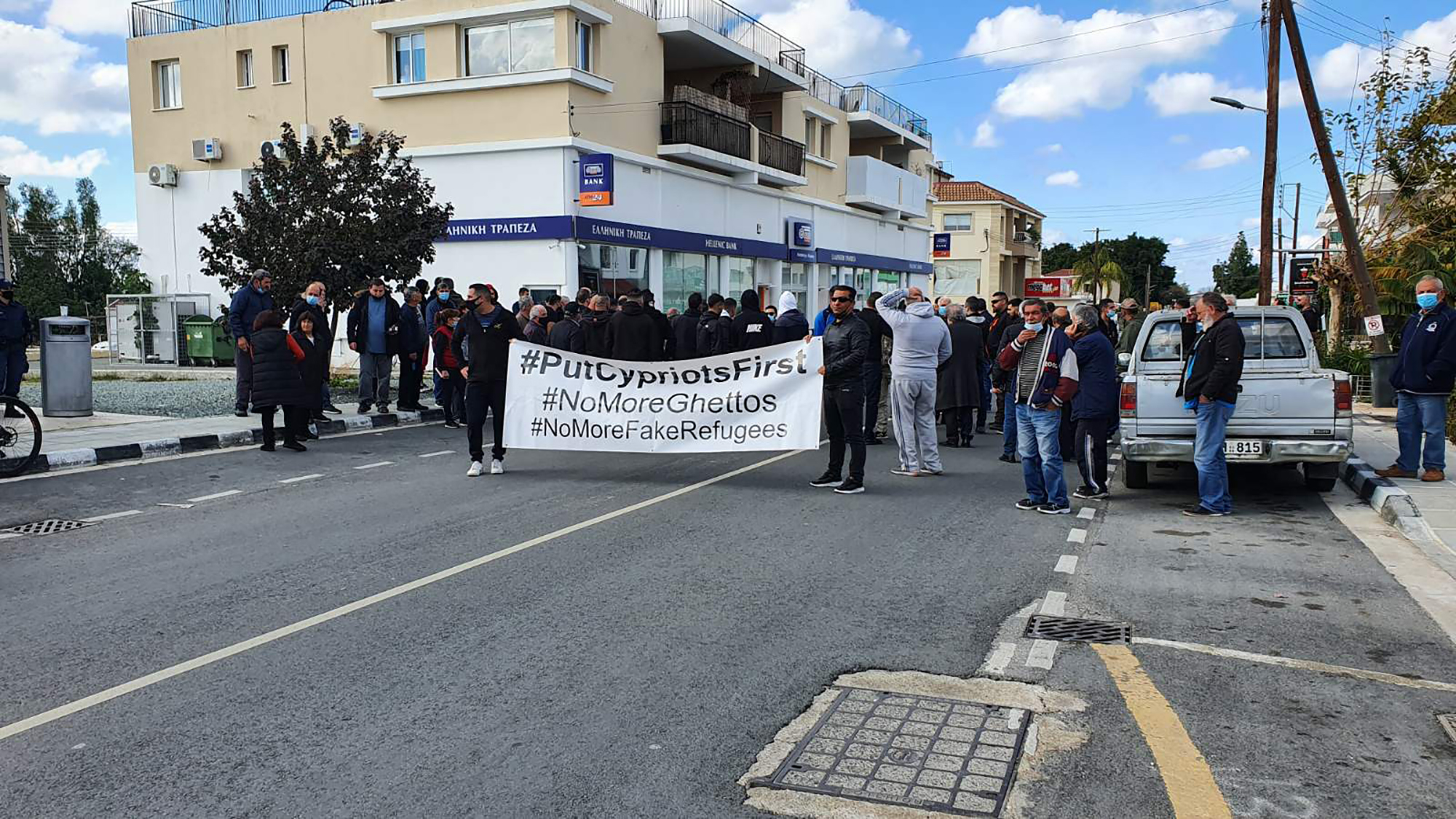
Dozens of people gathered on Eleftherias Street at 11am demanding the state provide a permanent solution regarding the presence of migrants in the area which has created a “ghetto” situation, according to the president of the community council Nicolas Liasides.
Rubbishing claims suggesting the residents are being racist, Miranta Ilia Hadjieconomou, who lives in Chlorakas, said their children “cannot go outside”, especially near a specific Ayios Nicolaos apartment complex where hundreds of Syrian migrants have settled.
Liasides described the apartment complex as a “concentration camp”, and said that despite locals’ appeals, the relevant ministries have not responded to their demands.
A solution must be found to transfer the migrants “to another safe place”, said Disy MP Charalambos Pandjiaros, who participated the protest.
“In Chlorakas, there is a ghetto, there is illegality, fear among the residents, insecurity and the demography has been altered,” Diko MP Chrysanthos Savvides said at the protest, while appealing to the state “to return the illegals to their homes”.
Meanwhile, the 600 Syrian war refugees who live in the Ayios Nicolaos apartment complex will also stage a protest on Monday, to demand the reconnection of the water on the premises.
The water was disconnected following financial disputes between the refugees, local authorities and the owners of the complex, Philenews reported.
“Depriving people of water is a violation of human rights and cannot be a tool to resolve economic disputes or to force residents to leave their homes,” the refugees said.
The demonstration is expected to take place at 11am on Monday outside the Paphos offices of the water development department.
According to interior ministry spokesman Loizos Michael, 1,500 of Chlorakas’ 4,000 residents are Syrians. Those have been involved in what he recently described to Al Jazeera as the “ghettoisation” of some communities.
The Middle East media network included an interview of a Syrian family who had fled Syria’s civil war ten years ago and settled in Chlorakas about a year ago, before authorities told them they could not live there.
“The authorities at the camp didn’t say anything about that when I presented my address and lease in May,” the father of the family said. “If they’d told me I wasn’t allowed to live in Chlorakas, I would have stayed in the camp. I’m not here to break laws.”
Paphos police carried out several sweeps in the past week to curb illegal migration in the area. On Friday night, four third-country nationals were arrested for violating the interior ministry’s decree banning the settlement of new migrants in the village. The four were charged in writing and released pending their court appearance.
The residents of the village had also protested last Friday holding banners reading #PutCypriotsFirst and saying they have had enough following two massive fights involving third-country nationals in the district.
Fifteen people have been arrested so far, including two who participated in both fights.
