
The construction of the new mobile desalination plant in Mazotos is entering the implementation trajectory, following the issuance of the reasoned finding of the Environmental Authority on April 8, 2026.
The project, which is classified as urgent, is the spearhead of the national strategy to deal with the prolonged drought.
With the cost estimated at €85 million. and the licensing process running at a fast track pace, the government aims to start work within June, with a completion horizon of December of this year.
The Environmental Authority came up with the location "Makaronia" in Mazotos, after an exhaustive evaluation and rejection of three other alternative sites (Softades, Maroni, Psematismenos).
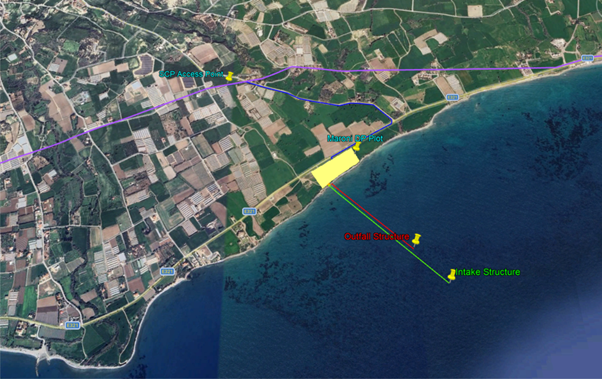
The rest of the areas were blocked due to:
Military restrictions: Existence of firing ranges and exclusion zones of the National Guard.
Environmental barriers: Presence of protected Posidonia meadows and reefs.
Land Use Conflicts: Proximity to tourist zones and bathing areas.
On the contrary, the chosen location in Mazotos, despite the increased technical requirements for a larger onshore pipeline 3,700 meters long, was judged as the only manageable solution that balances between national security and ecosystem protection.
The plant will operate with reverse osmosis technology and will have the capacity to initially produce 20,000 cubic meters of drinking water per day, with a prospect of up to 40,000 cubic meters per day.
The project will be fully automated through a Supervisory Control and Data Acquisition (SCADA) system, ensuring continuous control of water quality and infrastructure operation.
The reasoned finding of the Environmental Authority was based on thorough studies (Marine Ecological Study and Brine Dispersion Study). As noted, the seabed at the discharge point is mainly sandy with limited biodiversity, which reduces the ecological risk. However, the Environmental Authority set strict conditions for the protection of coastal vegetation and the monitoring of salinity.
Interestingly, the Dispersion Study was carried out with the "adverse scenario" of 50% recovery, to ensure that even under extreme conditions, the discharge of the brine will not disturb the marine environment.
The time pressure is obvious. With the Council of Ministers having approved a special decree that bypasses time-consuming urban planning procedures, the roadmap is as follows:
23/03/2026: Submission of data by the Water Development Department.
08/04/2026: Issuance of Environmental Approval.
June 2026: Contractor assignment and start of projects.
December 2026: Delivery and start of water supply.
The operation of the unit has a planned horizon of seven years, being a vital injection into the water balance of Cyprus, which is being severely tested by the climate crisis.
The Water Development Department, before reaching the decision for a desalination plant in Mazotos, proceeded to reject three alternative sites. The choice was not accidental, as it came up against a combination of military constraints, environmental sensitivity and urban planning obstacles.
Softades and Maroni: These two areas, despite their relative proximity to the existing water supply network (pipelines 1,700m – 2,050m), were excluded for reasons of national security. Both positions fall within the Exclusion Zone of Military Activities. The operation of a desalination plant was deemed incompatible, as vibrations from military exercises could cause accidents or damage to infrastructure.
In Softades, declared archaeological monuments were found, while in Maroni the sea area has a complex mosaic of protected Posidonia meadows and reefs, making licensing almost impossible.
Lying: The site in Psematismenos (near Zygi) was considered the most problematic from a social and environmental point of view. The area falls under zones T3e and T3b. The installation of an industrial plant would cause visual and sound pollution in a developing tourist area.
Due to existing port projects and breakwaters, the sea area has limited dispersion capacity. The addition of brine would lead to a local excessive increase in salinity. A large part of the plots falls under the Beach Protection Zone.
Mazotos: Although Mazotos presents the greatest technical challenges, it was judged as the only viable solution.
The Environmental Authority gave the green light for Mazotos based on the following data:
Marine background: The bottom at the discharge point is made up of sand and silt, with poor fauna, which means that the brine will have the least possible impact.
Distance from settlements: The unit is 2 km from the core of Mazotos and 1.4 km from the nearest residential zone, reducing the immediate nuisance.
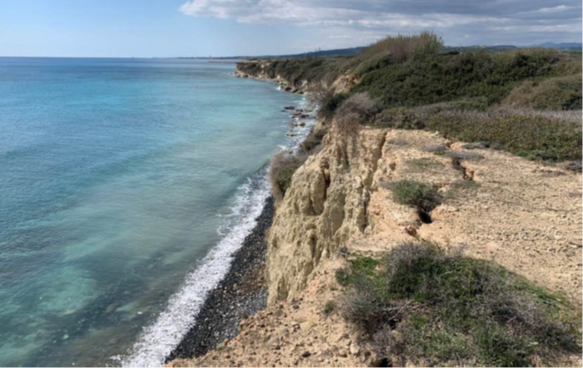
Mitigation measures: Despite the deforestation of limited coastal phryganic vegetation, the main maquis vegetation of the area (acacias, lentisks) will remain intact as planned.
The choice of Mazotos is a strategic decision that prioritizes the national need for water, accepting the higher construction costs due to a large pipeline in order to avoid insurmountable legal and environmental obstacles that would delay the project for years.
The three conditions of the Ministry of Defense
The Ministry of Defence played a crucial role in the location of the unit, as the wider area between Larnaca and Limassol is a vital area for the activities of the National Guard.
While the positions in Softades and Maroni were rejected without discussion due to the immediate proximity to firing ranges, for the selected location in Mazotos the Ministry set strict terms and conditions in order to ensure that the desalination operation will not interfere with the operational readiness of the armed forces.
According to the Reasoned Finding, the consent of the Ministry of Defence is accompanied by the following prerequisites:
1. The unit will be constructed in full awareness of the adjacent operation of the Kiti Firing Range and no nuisance or danger issues will be invoked in the future or a request for the reduction of the training activities of the National Guard. It is desirable that during the firing (up to 25 days per year), no staff work inside the unit, according to the firing announcements.
2. No further permission for the development of pieces will be given, invoking the "precedent" created by the said approval of the Ministry of Defense.
3. The route of the pipeline to the sea should be as west as possible and in any case outside the danger zone of the Kiti Firing Range.
