
AGIOS NEOPHYTOS AND HIS ENKLEISTRA COME TO LIVE THROUGH AN INNOVATIVE DIGITAL PROCESS - Filenews 8/4 by Dora Christodoulou
An innovative digital revival of Saint Neophytos and his Enkleistra, in the famous monastery dedicated to the saint, in Tala, Paphos, will be officially presented in May.
The UNESCO Chair for Digital Cultural Heritage at the Digital Heritage Laboratory and its "Mnemosyne" Research Center at CUT, announced today this important innovation in the context of a European project on digital cultural heritage.
The 12th-century Enkleistra of Saint Neophytos, together with Saint Neophytos the Recluse himself, come to life through high-quality three-dimensional digitization, advanced Artificial Intelligence and innovative Virtual and Augmented Reality technologies.
For the first time in Europe, this innovative venture goes beyond the concept of the "Digital Twin" and introduces the "Memory Twin", a transformative approach, where cultural heritage is not just digitally reproduced, but enriched with knowledge, narratives and experiential experiences. In this context, the project marks a defining value, as a monument that truly "speaks", conveying its history, meaning and cultural value through advanced, technologies.
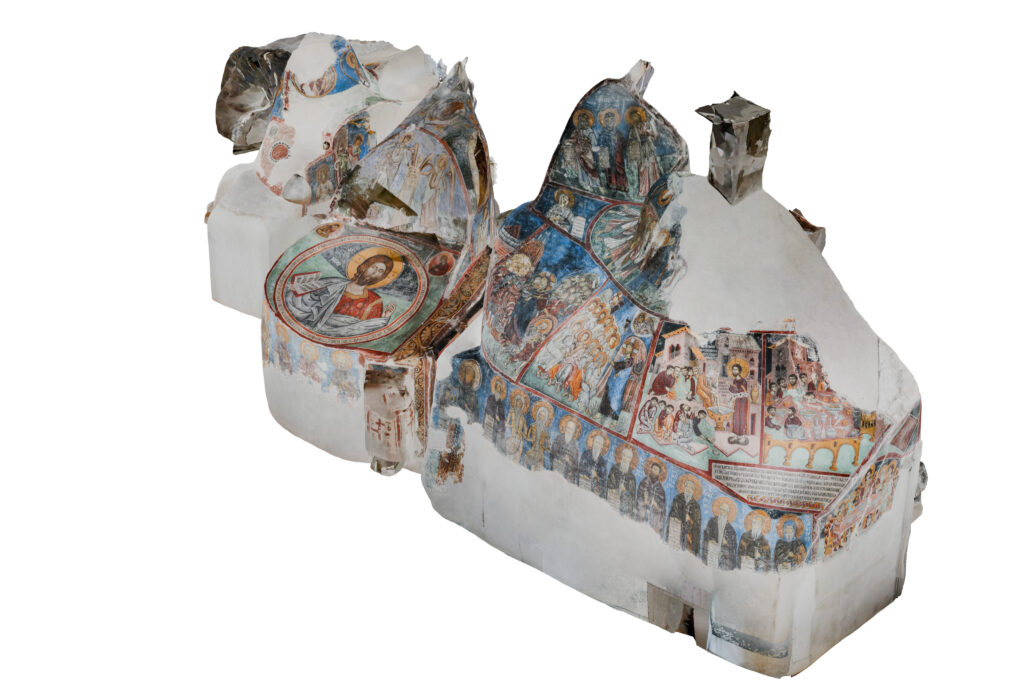
This exceptional innovation was made possible thanks to the collaboration of the two project partners, MIRALab in Geneva and the Digital Heritage Lab of CUT. This important presentation will take place for the public on May 24, after the Divine Liturgy, in the area of the Enkleistra of Agios Neophytos, in the Monastery of the Saint, in Tala. The event is part of the Digital Cultural Heritage 2026 Summit, which will take place in Limassol in May and is under the auspices of the Cyprus Presidency of the Council of the European Union.
According to the organizers, this pioneering project, which will be presented for the first time in Cyprus, transforms a variety of cultural goods into two-dimensional and three-dimensional form, videos, texts, maps and narratives, creating unique experiences. The Enkleistra of Agios Neophytos is one of the three emblematic monuments selected for this project, along with the archaeological site of Bibracte in France and the walls of Girona in Spain, which will be presented on the first day of the conference.
The Enkleistra of Saint Neophytos, it is pointed out in a relevant announcement, is a special Byzantine monument, not only for Cyprus, but also for the entire Byzantine world. The cave was personally chosen by Agios Neophytos, who carved it in 1156. It functioned as a place of residence, study and spiritual exercise. Later, when he founded a monastery, Enkleistra was his core and, after his death, after he was buried there, the site became a funerary monument, continuing to this day as an important pilgrimage destination.
Artistically, the monument is equally unique. His iconographic program, designed by the Saint himself, was executed by artists with a deep knowledge of the Byzantine painting of the capital and not of provincial models, as one would expect to see in a remote cave in Cyprus, on the periphery of the empire. Therefore, Enkleistra is a prominent example of Komnenian art and a monument of global cultural importance.
In collaboration with MIRALab Geneva and the Digital Library of the European Union, the UNESCO Chair for Digital Cultural Heritage will present for the first time in Europe the results of a long-standing and pioneering collaboration. This achievement, it is emphasized, is the first complete demonstration of the entire digital cultural heritage chain, from the creation of certified high-quality three-dimensional content to its enrichment through Artificial Intelligence and its presentation with XR technologies, directly in its physical space.
Building on the European Union Innovation Award, which the Digital Heritage Lab received in 2018, the UNESCO Chair has now achieved an important milestone in documenting the past through the Memory Twin Methodology – which will be presented at the Enkleistra of Agios Neophytos, on May 24. This innovation introduces a new paradigm in the digital transition of the 21st century, where cultural heritage is no longer static, but is transformed into a living, intelligent repository of memory, knowledge and human experience for the benefit of future generations.
According to the project managers, the project is designed to promote broad public participation, with a particular focus on pupils and students of all levels of education, while at the same time meeting the needs of academics, multidisciplinary professionals, political and cultural institutions. It actively supports education, research, scientific and cultural diplomacy, highlighting the transformative potential of digital technologies in the field of cultural heritage.
The introduction of the MemoryTwin concept is a groundbreaking innovation for the electronic documentation of the past in the digital 21st century, opening new avenues for humanity, even where it can preserve not only the form, but also the meaning, memory and collective intelligence of cultural heritage in an increasingly digital world.
