Filenews 21 February 2026 - by Angelos Nikolaou

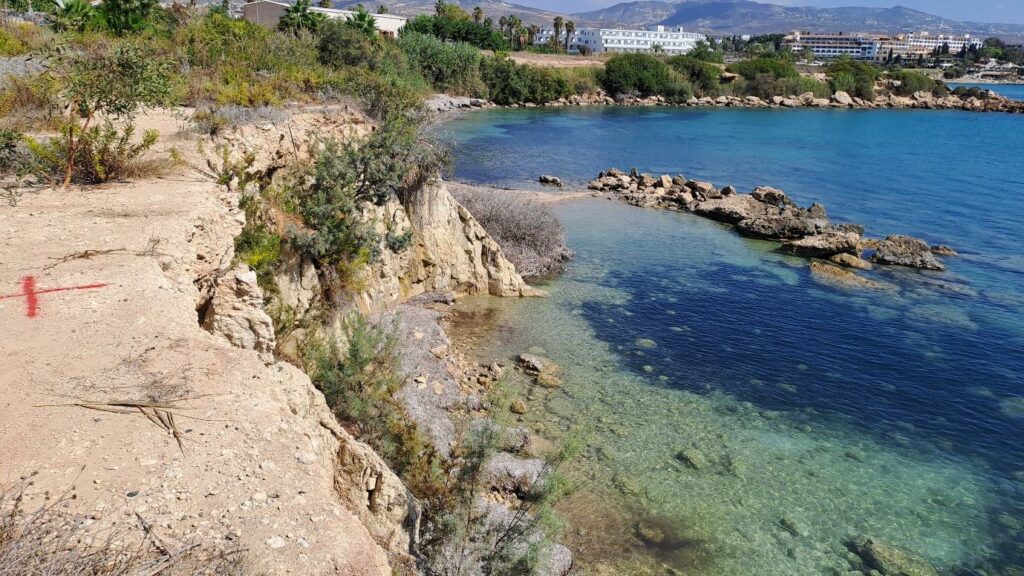
The phenomena of intense erosion in Keratidi Bay now directly threaten to swallow public infrastructure and luxury residential developments in Pegeia. According to the Information Report submitted to the Environmental Authority, the situation is described as critical, with the coastal front retreating dangerously, now only 3 to 5 meters from the public pedestrian street.
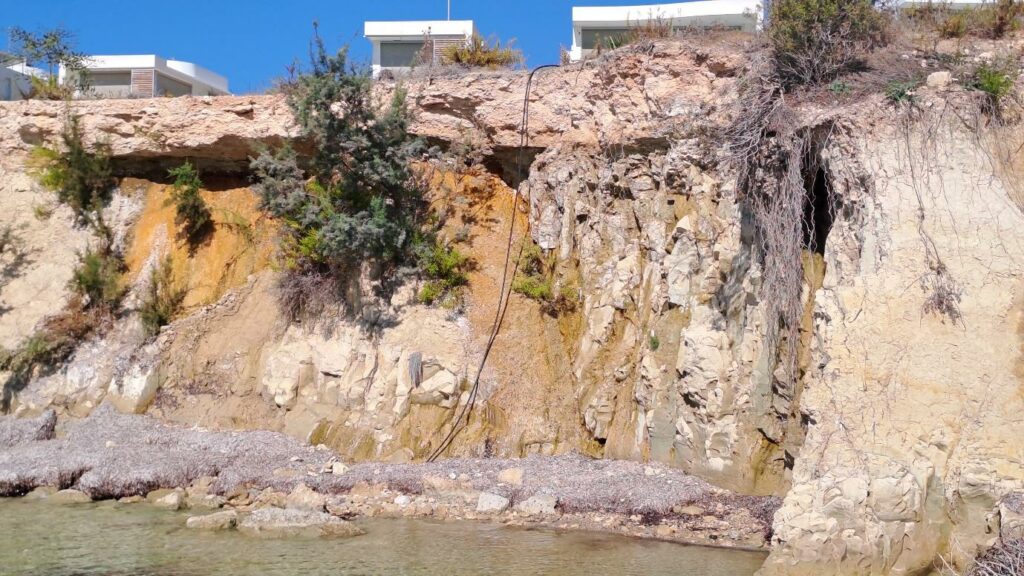
The study of the office "Dion. Toumazis and Associates", prepared in November 2024, reveals a disturbing picture. Although the coastline seemed stable in the past, in the period 2014-2019 there was an increase in erosion with intense undermining of the cliff. According to the researchers, from 1963 to 2014 there was retreat/erosion of the coastline of about 16 meters in the eastern bay and about 10 meters in the western bay. Furthermore, they note, from 2014 to 2019 there was subsidence/erosion of an additional 5 meters in the eastern bay and about 5 meters in the western bay. That is, there was an average decline of 1 meter per year.
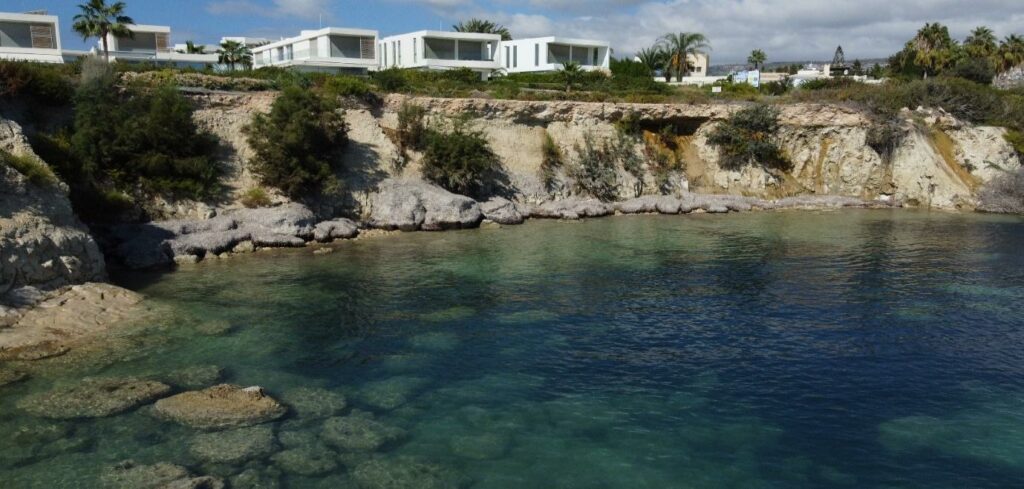
Researchers warn that at the current rate it is only a matter of time before the collapse of the public coastal promenade and the green space, while the tangential public road has already been damaged, with parts of it now located... at sea.
The project aims to improve the safety of the public. The proposed solution for the protection of the base of the cliff (foot) is inspired by the natural protection process observed on the neighbouring cliffs, where the undermining by the waves is limited through the movement of fine-grained materials. Smaller particles are carried by the waves, while larger and more stable materials remain on the foot, capable of resisting maximum waves.
Due to the urgency, the applicants (owners of the Coral Seas development), in consultation with the Paphos District Administration, propose a package of immediate protection measures, with a total cost of €300,000 and a duration of works of 5 months:
• Construction of a wall of two rows of piles 12 meters deep, in a length of 40 meters parallel to the pedestrian street. The structure will be underground, so as not to cause visual nuisance, ensuring the stability of the ground.
• Placement of natural boulders at the base of the cliff (foot) at a height of 4-6 meters from the sea. The aim is to absorb the energy of the wave and limit the undercut.
"Failure to take measures entails significant risks to the safety of visitors and frontline buildings," the report said, stressing that the solution of general protection measures for the entire bay would require up to a decade that the area does not have.
The problem of the stability of the cliff is addressed by other councillors (Giorgos Petridis and Kyriakos Kyrou). According to experts, the only immediately applicable and effective solution is to promote specific measures to protect the coastal front and houses in the area in front of the Coral Seas project. "It is clear that with the current average rates of erosion of the coastal front, it is possible that there will soon be a risk of collapse of the public coastal promenade and public greenery and damage to the complex itself. Erosion is not progressing at a steady pace and nor can it be predicted when it will affect the coastal promenade and homes. Extreme sea wave events can bring about a sudden deterioration of the situation," the researchers say.
Petridis and Kyrou suggest to address the problems of erosion and stability of the coastal front despite the Coral Seas project, the construction of a buried wall of piles in front of the coastal promenade and the protection of the cliff locally with boulders. "A feasible and practical solution that largely ensures the safety of the coastal front in this area," they conclude.
Red from the Department of Antiquities on the underwater wealth
The area is not only geologically sensitive but also archaeologically heavy. The Department of Antiquities, in a letter dated . 28/7/2025, underlines that Keratidi Bay is an important archaeological site, as underwater research has identified a large concentration of material that testifies to the existence of an ancient anchorage. It is noted that the bay is located in the immediate vicinity of the archaeological site of Maas-Paleokastro. Although the need for protection is recognized, the Department of Antiquities calls for a clear demarcation of the interventions on paper, warning against altering the physiognomy of the area.
The researchers, however, are reassuring, noting that the works will be carried out within state land and at the points of contact with erosion, without affecting the seabed where the antiquities are located.
The project is located within the Beach Protection Zone, just 260 meters from the organized beach "Laurou". The study argues that the use of natural boulders is a "nature-based solution", which will reduce the reflection of the waves and stabilize the slope without affecting the neighbouring coasts.
With the Municipality of Pegeia planning the extension of the coastal promenade to the Sea Caves, the need for a safe front is now imperative for the local community and the tourism industry of Paphos.
